













The global landscape of mobility and trade is currently experiencing a transformative phase, making the continuous evolution of physical and digital transit networks more critical than ever. As cities expand and global commerce accelerates, the transportation infrastructure market stands at the forefront of this monumental shift. This comprehensive market report provides an in-depth forecast for the industry from 2025 to 2035, detailing the fundamental drivers, emerging trends, structural segment shifts, and regional developments that are expected to shape the future of global connectivity.
Market Overview and Forecast Valuation
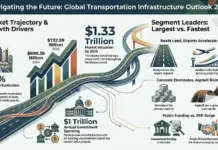
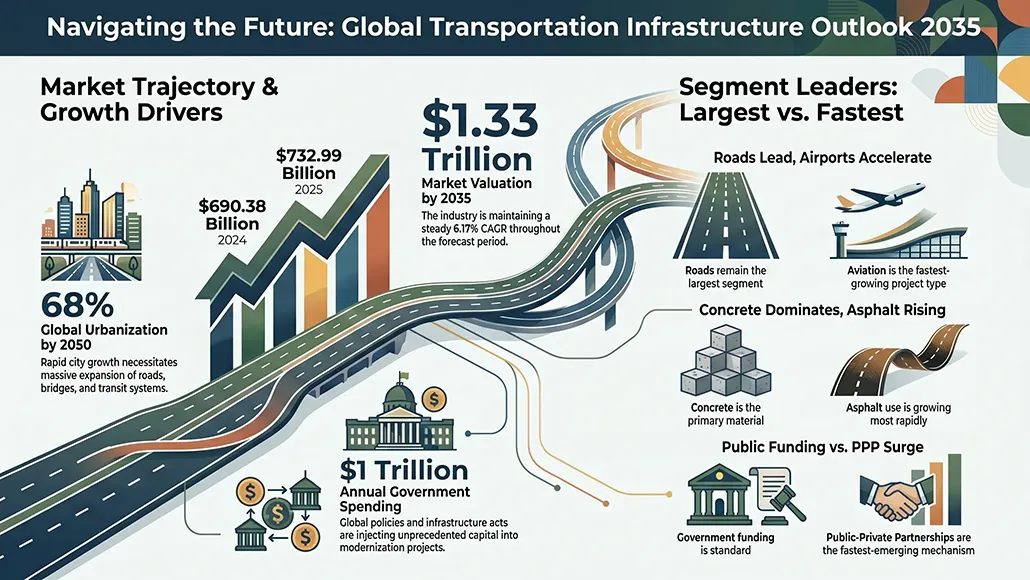
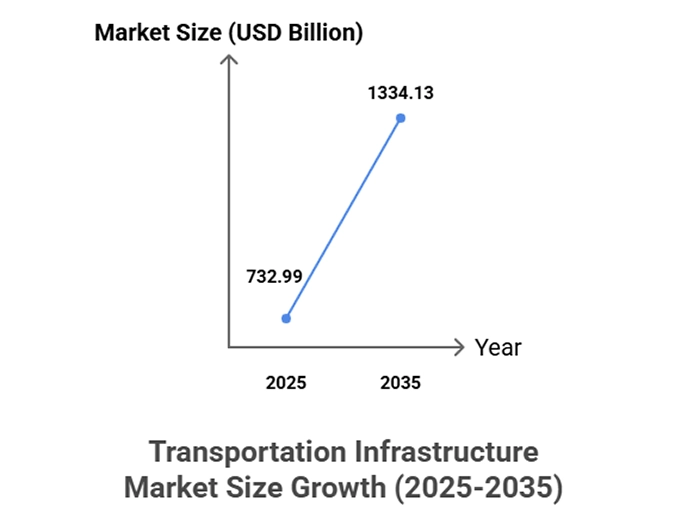
Transport Advancement believes the industry is poised for substantial and sustained growth over the next decade, fueled by technological advancements, urbanization, and critical government investments. In 2024, the market was estimated at a valuation of 690.38 USD Billion. Moving into the forecast period, the market size is projected to grow from around 732.99 USD Billion in 2025 to surge to an impressive 1334.13 USD Billion by the year 2035. This trajectory represents a robust compound annual growth rate (CAGR) of 6.17% from 2025 to 2035.
Primary Market Drivers
The anticipated expansion of the market is underpinned by several critical macroeconomic and socio-economic drivers.
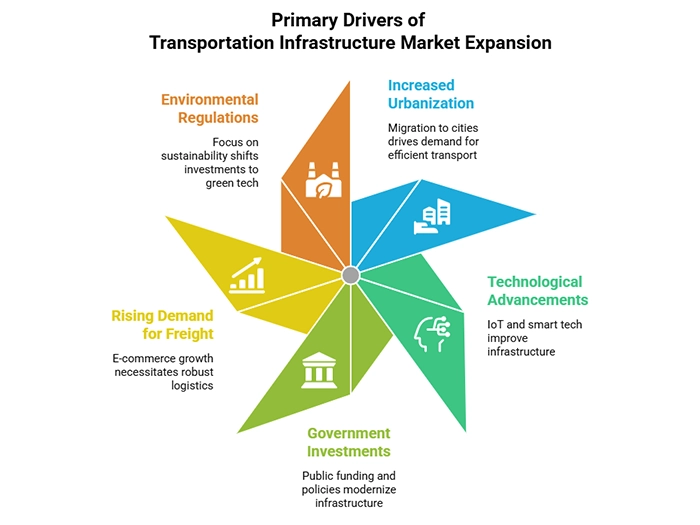
- Increased Urbanization: The rapid pace of global urbanization is an undeniable primary driver. As populations migrate to urban centers, the demand for highly efficient transportation networks escalates dramatically. Projections indicate that urban areas will house approximately 68% of the world’s population by the year 2050. This profound demographic shift necessitates urgent expansion and modernization of roads, public transit systems, and bridges to alleviate congestion and accommodate daily commuters.
- Technological Advancements: Innovations are fundamentally reshaping how infrastructure is designed, built, and maintained. The integration of the Internet of Things (IoT) allows for real-time data collection, which drastically improves traffic flow and overall safety. These technological leaps are expected to spur massive capital injection, with estimates suggesting that the smart transportation sector alone could reach a valuation of 200 USD Billion by 2025.
- Government Investments and Policies: Public sector financial commitment is vital for the modernization of aging infrastructure. Current reports project that global infrastructure spending will exceed 1 Trillion USD annually by 2025. These budgets are frequently paired with new government policies designed to promote sustainable practices, minimize emissions, and vastly improve public transportation options.
- Rising Demand for Freight and Logistics: The explosion of global trade and e-commerce has severely intensified the need for robust freight and logistics networks. The wider logistics market is forecast to reach 12 Trillion USD by 2027, making modernized railways, roadways, and ports absolutely essential to enhance supply chain efficiency and reduce delivery timelines.
- Environmental Regulations: Growing concerns regarding climate change have led to the implementation of strict regulations designed to curb carbon emissions. Consequently, investments are heavily shifting toward greener technologies, such as energy-efficient transit networks and electric vehicle charging infrastructure. The sustainable transportation solutions segment is anticipated to expand at a CAGR of over 10% in the coming years.
Emerging Market Trends
As the market grows, a clear shift in operational philosophy is becoming apparent. Stakeholders are heavily prioritizing sustainability initiatives, recognizing the urgent need for eco-friendly solutions. Infrastructure projects are increasingly designed to reduce carbon footprints by utilizing renewable materials and encouraging public transit usage.
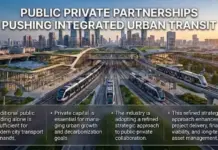
Simultaneously, the development of smart infrastructure is becoming standard practice rather than an exception. The integration of artificial intelligence (AI), big data analytics, and IoT into these systems ensures adaptive and highly responsive transportation networks. To fund these complex, large-scale modernizations, Public-Private Partnerships (PPPs) are becoming the preferred collaborative approach. By combining public oversight with private sector efficiency and capital, PPPs reduce overall costs, improve service delivery, and foster innovative infrastructure solutions.
Market Segmentation and Shift Analysis
To fully understand the changes within the transportation infrastructure market, it is crucial to analyze the specific segment shifts and material preferences shaping project execution.
- Project Type: Roads and Highways vs. Airports and Aviation The Roads and Highways segment historically dominates the market, maintaining the largest overall share due to its foundational role in rural and urban mobility. Driven by continuous upgrades and vast vehicular volumes, this segment is projected to expand significantly by 2035. Conversely, the Airports and Aviation segment is identified as the fastest-growing sector. Benefiting heavily from globalization and a massive worldwide surge in air travel demand, airport infrastructure is undergoing rapid innovation, incorporating smart technologies and green initiatives to handle growing passenger volumes.
- Construction Material: Concrete vs. Asphalt Concrete remains the dominant construction material in the industry, favored for its structural integrity, immense durability, and ability to withstand harsh weather conditions. Reflecting its critical importance, concrete is expected to climb higher by 2035. However, Asphalt is rapidly emerging as the fastest-growing alternative. Modern asphalt formulations are increasingly environmentally friendly, cost-effective, and allow for much faster installation processes, making them highly attractive for urgent road and highway expansions.
- Funding Mechanism: Public vs. Public-Private Partnerships (PPPs) Public funding remains the dominant financial mechanism, ensuring consistent capital for essential large-scale public welfare projects. However, facing budget constraints and the need for advanced technological integration, the market is witnessing a rapid shift toward Public-Private Partnerships (PPPs). As the fastest-growing funding avenue, PPPs allow for essential risk-sharing, enhanced operational efficiency, and a necessary degree of privatization to drive innovation.
- Smart Features: Traffic Management vs. Intelligent Transportation Systems Within the technological segment, Traffic Management Systems hold the dominant market share, providing indispensable features such as accident monitoring, congestion management, and real-time traffic updates. Meanwhile, Intelligent Transportation Systems (ITS) represent the fastest-growing feature set. Driven by advanced data analytics and IoT interoperability, ITS connects various transportation modes to create a seamless user experience.
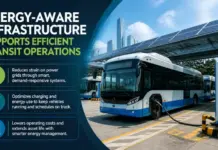
- Sustainability Considerations: Energy Efficiency vs. Recycled Materials Energy Efficiency is currently the largest focus within sustainability considerations, driven by the immediate need to lower operational costs and fulfill green building certifications throughout project lifecycles. In parallel, the utilization of Recycled Materials is the fastest-growing trend in this segment. Driven by circular economy principles and strict environmental regulations, utilizing repurposed materials allows developers to significantly minimize waste and achieve broader sustainable development goals.
Regional Market Insights
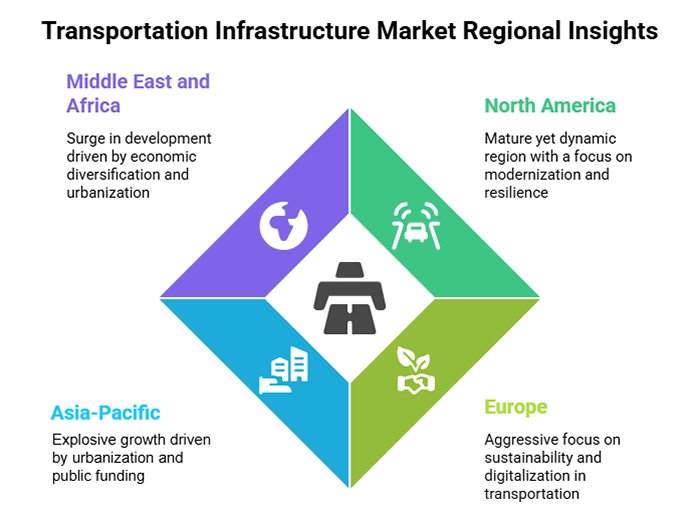
The geographical landscape of the transportation infrastructure market reveals diverse investment priorities and growth drivers across different global regions.
- North America: Representing a mature yet highly dynamic region, North America is a leader in infrastructure investment. The United States commands approximately 70% of the regional market share, followed by Canada at 15%. Growth in this region is primarily driven by the urgent need to modernize aging infrastructure, heavily supported by massive federal funding initiatives and the widespread adoption of public-private partnerships to enhance overall network resilience.
- Europe: Europe stands out for its aggressive focus on sustainable development and digitalization. Germany and France are the largest regional contributors, holding roughly 30% and 20% of the market share, respectively. Propelled by stringent regulatory frameworks like the European Green Deal, the European market is channeling significant investments into extensive, eco-friendly rail and road networks.
- Asia-Pacific: Characterized by explosive urbanization and population booms, the Asia-Pacific region exhibits incredibly rapid market growth. China completely dominates the regional landscape, accounting for an estimated 50% of the market share, while India follows with 15%. The primary focus in this region is the aggressive expansion of internal connectivity through immense public funding directed at new road and rail networks, combined with a strong emphasis on integrating smart infrastructure solutions.
- Middle East and Africa: Driven by broad economic diversification efforts and rapid urbanization, this region is witnessing a major surge in infrastructure development. The United Arab Emirates and South Africa represent the largest markets, holding approximately 25% and 20% of the regional share, respectively. Government-led initiatives and PPPs are unlocking significant funding to facilitate large-scale transit projects aimed at improving regional integration and supporting long-term economic growth.
Future Outlook and Opportunities
Looking toward the horizon of 2035, the market is expected to demonstrate robust strength, characterized by deep innovation and structural modernization. The consistent 6.17% CAGR from 2025 to 2035 highlights the essential nature of the sector. Future market opportunities will heavily rely on the successful development of smart transit systems powered by AI and IoT, the rapid deployment of electric vehicle charging networks across expanding urban centers, and sustained investments in zero-emission public transit solutions. As global demographics and environmental priorities continue to shift, Transport Advancement emphasizes that adapting to these critical trends will remain paramount for the continued evolution of worldwide mobility.
