














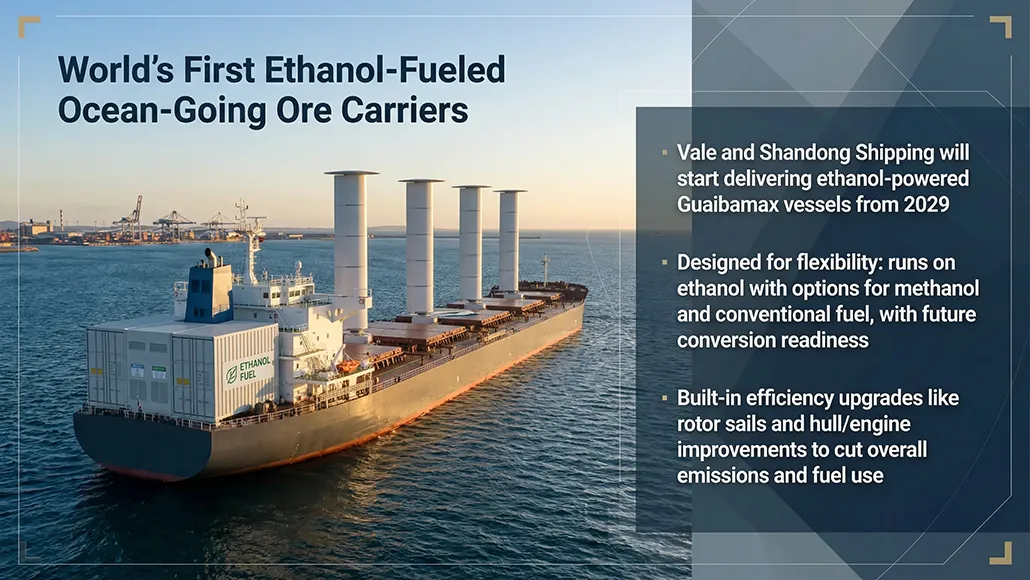
Vale and Shandong Shipping Corporation have formalized an agreement to develop ethanol-powered Guaibamax vessels, with deliveries set to begin in 2029. The deal represents a landmark moment for iron ore logistics and introduces the world’s 1st ethanol-fueled ocean-going vessel in the maritime sector. For the first time, ethanol will serve as the primary fuel on an ocean-going vessel, positioning the initiative at the forefront of shipping decarbonization. With the ability to cut carbon emissions by around 90% compared to heavy fuel oil, widely used across global fleets, the move strengthens Vale’s strategy to reduce emissions throughout its value chain. It also aligns with ongoing discussions at the International Maritime Organization (IMO), further highlighting the industry relevance of the 1st ethanol-fueled ocean-going vessel.
Under the agreement, Vale and Shandong have entered into 25-year contracts covering the construction of two ships, with provisions for additional vessels. These second-generation Guaibamax units, measuring 340 meters in length and offering a capacity of 325,000 tonnes, form part of Vale’s broader multi-fuel approach. While ethanol is central to the design, the ships will also operate on methanol and heavy fuel oil, with the flexibility to be converted for liquefied natural gas (LNG) or ammonia in the future. This adaptability ensures that the 1st ethanol-fueled ocean-going vessels remain compatible with evolving fuel technologies and regulatory frameworks.
“Vale’s pioneering efforts towards decarbonization in maritime transport are guided by a strategy that combines flexibility and efficiency. The use of ethanol as fuel in the ships that transport our ore, combined with the adoption of rotor sails to harness wind energy, places Vale in a unique position for the energy transition in global shipping over the coming decades, whilst driving similar initiatives in the sector”, says Rodrigo Bermelho, Vale’s Director of Shipping.
From a lifecycle perspective, ethanol offers significant environmental benefits. When assessed on a well-to-wake basis, second-generation ethanol can reduce emissions by approximately 90% compared with heavy fuel oil. Beyond shipping, Vale is also advancing ethanol adoption in its logistics network, including trials involving trucks and locomotives on the Vitória a Minas Railway (EFVM). The company’s investment in the 1st ethanol-fueled ocean-going vessel complements these broader initiatives, reinforcing its commitment to lowering emissions across transport modes.
The new vessels will share similarities with 10 dual-fuel ships that Shandong is scheduled to deliver to Vale from 2027 onwards. The upgraded Guaibamax generation will feature five rotor sails designed to harness wind energy, alongside enhanced engines, hydrodynamic improvements, a shaft generator, frequency inverters and silicone paint. Together, these technologies are expected to reduce greenhouse gas emissions by around 15% compared to current models. These innovations are part of Vale’s Ecoshipping program, a research and development platform focused on improving fleet efficiency and supporting maritime decarbonization. Since 2020, Vale has invested around US$ 1.4 billion to cut Scope 1, 2 and 3 emissions, with a target to reduce Scope 3 emissions by 15% by 2035, particularly those linked to maritime transport.
