















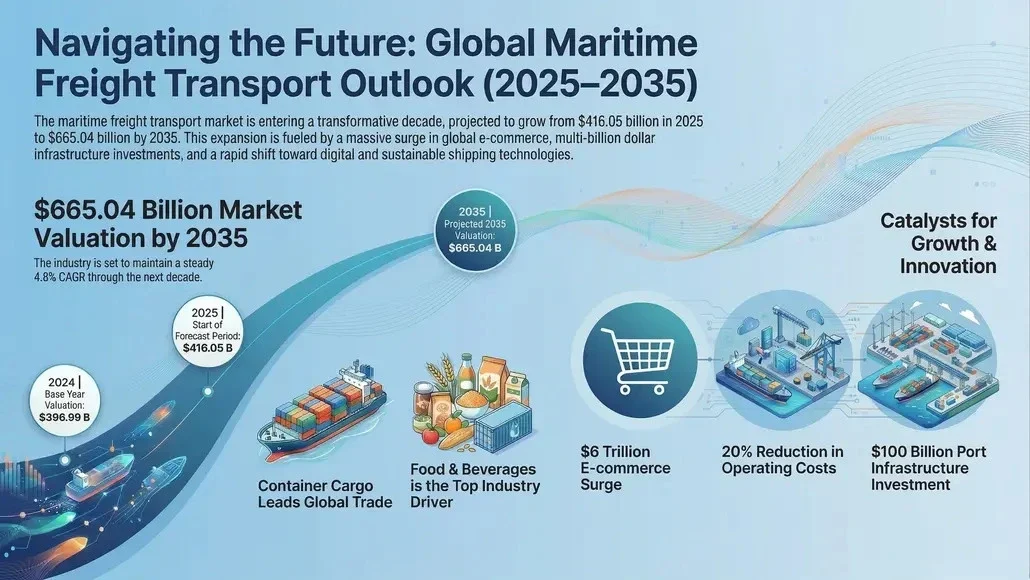
The global trade ecosystem relies almost entirely on the efficiency and scale of ocean-bound logistics, and the maritime freight transport market is currently positioned at the precipice of a significant, long-term transformation. Operating as the central artery for international commerce, this sector connects continents, powers industrial manufacturing, and ensures the continuous flow of consumer goods worldwide. As the global economy continues its expansion and trade routes become increasingly interconnected, the industry is projected to experience highly consistent growth. Recent forecasts indicate that the market will increase from 416.05 USD Billion in 2025 to an impressive 665.04 USD Billion by the end of the year 2035. This upward trajectory represents a compound annual growth rate (CAGR) of 4.8% during the comprehensive 2025-2035 forecast period. Transport Advancement observes that the fundamental shifts driving this massive expansion encompass a broad spectrum of structural changes, ranging from sweeping technological breakthroughs to stringent environmental regulations and rapidly evolving global trade dynamics.
Primary Macroeconomic Growth Drivers
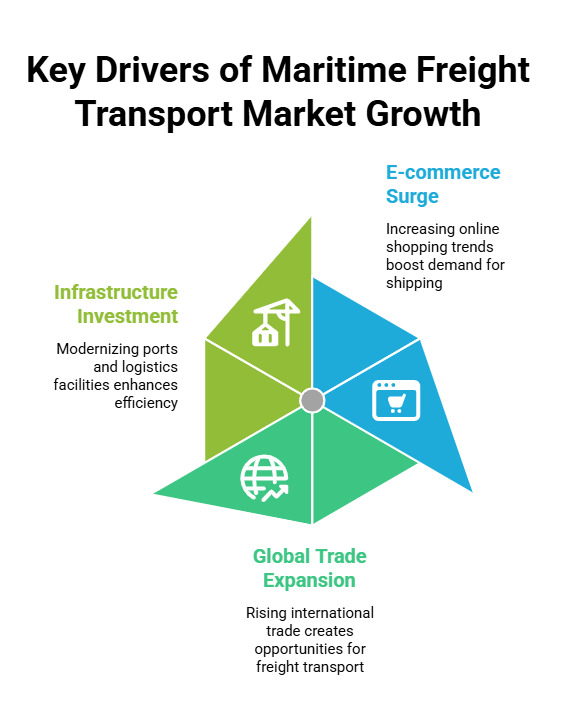
The sustained growth of the sector is supported by several foundational economic pillars. A primary catalyst for the sector is the unrelenting, worldwide surge in e-commerce activities. As consumer purchasing preferences shift increasingly toward online shopping, the demand for highly efficient, high-volume shipping solutions has surged proportionately. It is estimated that global e-commerce sales will reach a staggering 6 trillion USD in 2025, an economic milestone that necessitates expansive and highly robust maritime capabilities to transport growing volumes of consumer goods across oceans.
Furthermore, as global economies recover from cyclical downturns and consumer demand rises in emerging markets, global trade volumes are projected to see a steady annual increase. This sustained expansion of international trade presents massive, lucrative opportunities for freight transport providers to expand their service fleets and enhance their global market presence.
To successfully support this massive influx of traded goods, both governmental bodies and private corporate entities are heavily investing in critical port infrastructure and advanced logistics facilities. In the year 2025 alone, global capital investments aimed at modernizing aging port infrastructures to accommodate significantly larger cargo vessels and substantially reduce turnaround times are expected to exceed 100 billion USD. This immense influx of capital is highly likely to bolster the efficiency of the entire sector, facilitating dramatically smoother operational workflows and attracting larger shipping conglomerates to utilize these newly upgraded, state-of-the-art facilities.
Transformative Market Shifts and Trends
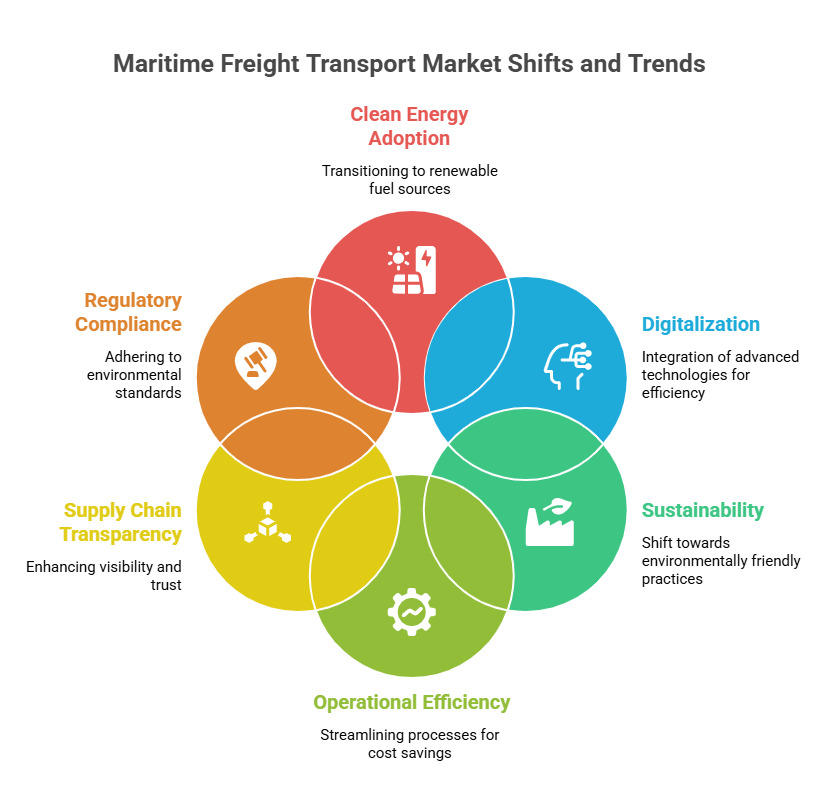
The maritime freight transport market is currently undergoing a digital revolution that is fundamentally rewriting traditional operational playbooks. Industry stakeholders are aggressively integrating advanced digital technologies, including sophisticated artificial intelligence (AI), predictive data analytics, and highly secure blockchain technology, to enhance daily operational efficiency and establish unprecedented supply chain transparency. The integration of these intelligent, smart shipping solutions is anticipated to yield significant operational and financial benefits, with current market projections showing that technological adoption could lead to overarching operational cost reductions of up to 20% by the year 2026. This digitalization wave not only optimizes highly complex supply chain management but makes the entire maritime sector far more competitive.
Running completely parallel to this digital transformation is a monumental, industry-wide shift toward sustainable shipping practices and stringent environmental compliance. Driven by aggressive regulatory changes enacted by global governing bodies aiming to combat the escalating threat of climate change, the maritime logistics industry is actively moving away from its historical reliance on conventional fossil fuels. Most notably, the International Maritime Organization (IMO) has laid down highly ambitious, non-negotiable targets to reduce global greenhouse gas emissions within the sector by a minimum of 50% by the year 2050. Consequently, there is a rapidly accelerating trend in the sector surrounding the adoption of alternative, clean energy sources, the engineering of highly energy-efficient vessels, and the implementation of greener operational practices designed specifically to minimize the maritime sector’s overarching carbon footprint.
Cargo Type Segmentation Insights
An analysis of the distribution of cargo types highlights the diverse operational capabilities and specific logistical demands within the global maritime sector.
- Container Cargo: Container cargo is the long-standing dominant and largest segment in the market.. Its sheer dominance is heavily fueled by the unrivaled efficiency of intermodal transportation solutions that heavily favor standardized containerization. This segment is hyper-flexible, facilitating the global shipment of an incredibly wide range of goods, spanning from highly sensitive electronics to everyday perishable retail items.
- Bulk Cargo: Recognized rapidly as the fastest-growing cargo segment in the global market, this particular segment is absolutely vital for the continuation of international trade, specifically functioning to transport foundational raw commodities such as grain, industrial coal, and iron ore. The rapid growth of this segment is notably visible and highly concentrated within the expanding economies of the Asia-Pacific region.
- Oil & Gas Cargo: Operating as a cornerstone of the global energy matrix, this highly specialized segment commands a massive independent valuation. This reflects its critical, ongoing significance to the uninterrupted stability of the global energy supply chain.
- General Cargo: The general cargo operates on a far more adaptable, albeit fragmented, basis. This segment fundamentally caters to specialized, bespoke logistical needs that strictly do not fit into standardized containerization models, making it pivotal for the customized global trade of heavy machinery and uniquely dimensioned industrial goods.
Industry Type Segmentation Insights
The maritime logistics network functions as the backbone for a multitude of specific global industries, with highly distinct growth patterns uniquely observed across different manufacturing and retail sectors.
- Food & Beverages: Representing the absolute largest industry segment utilizing ocean freight, the Food & Beverages segment’s market dominance is strictly underpinned by the constant, unyielding global demand for perishable consumer goods. This segment relies exceptionally heavily on the deployment of advanced cold chain technologies and meticulous logistics to ensure product integrity across long, trans-oceanic voyages.
- Manufacturing: This critical sector holds a truly massive share of the shipping ecosystem. Its volume is continually driven by the complex, international exchange of industrial components, raw materials, and finished consumer goods.
- Oil & Ores: Formally identified as the fastest-growing industry category utilizing maritime logistics, the oil and ores segment is currently expanding at a rapid pace due to the surging global demand for raw energy and the foundational natural resources required for heavy industrial manufacturing. To effectively operate, this specific sector requires massive capital investment in highly specialized bulk transport vessels capable of handling immense physical weights.
- Electrical & Electronics: Fueled by the modern world’s reliance on technology, this specific industry segment is robustly projected to grow substantially.
Comprehensive Regional Market Dynamics
The overarching geographical distribution of the maritime freight transport market reveals fascinating strategic shifts and highly unique regional drivers currently shaping the future of global logistics.
- Asia-Pacific: This vast region is rapidly solidifying its definitive position as the ultimate emerging trade powerhouse, driven by unprecedented economic growth and escalating trade activities. Currently, China completely leads the regional market with a staggering 40% overarching share, functionally followed by Japan, which holds approximately 15% of the market. Significant, well-funded government initiatives aimed directly at streamlining complex logistics processes and aggressively enhancing port infrastructure are critically important for successfully accommodating the constantly rising cargo volumes across the Asian continent. Additionally, the region’s inherently strategic geographic location running directly along major, historical shipping routes further amplifies its vital significance in global trade.
- North America: Functioning reliably as a highly mature, major logistics and global trade hub, the North American region is experiencing highly robust growth fueled almost entirely by continuous advancements in digital logistics technology and expanding trade volumes. The United States currently commands the absolute largest market share in the region at an estimated 60%, with neighboring Canada firmly holding around 20%. Highly streamlined customs processing protocols and massive, targeted infrastructure investments in absolutely critical nodal ports, such as Los Angeles and Long Beach, continue to powerfully catalyze regional growth while heavily enhancing the ongoing digital transformation within regional shipping logistics.
- Europe: The European continent aggressively distinguishes itself as the unquestioned global leader in pioneering sustainable, eco-friendly maritime freight transport initiatives. Guided meticulously by the strict environmental parameters of the European Union’s Green Deal, which explicitly targets a staggering 55% reduction in total greenhouse gas emissions originating from commercial shipping by the year 2030, the region is actively investing billions in green technologies and the procurement of alternative fuels. Nationally, Germany and the Netherlands wholly dominate the European logistics market, actively holding impressive market shares of 30% and 25%, respectively.
- Middle East and Africa: Serving historically and presently as incredibly strategic, vital nodes for highly trafficked global trade routes, this specific region is actively undergoing a massive economic transformation through highly strategic, well-capitalized investments in port infrastructure and advanced logistical capabilities. The United Arab Emirates (commanding a 35% regional share) and South Africa (holding a 20% regional share) act as the primary market leaders. Developing regulatory frameworks specifically designed to aggressively facilitate international trade are continuously making this region highly attractive for the expansion of global shipping operations.
Future Market Outlook (2025-2035)
Looking dynamically ahead to the upcoming decade, the global sector is incredibly well-positioned for aggressive, dynamic expansion. The highly anticipated and officially projected 4.8% CAGR will be reliably sustained by continuous, disruptive innovations located at the absolute intersection of digital supply chain technology and green shipping mandates. Significant, highly lucrative new opportunities are fully expected to rapidly materialize in the specialized development of fully automated port logistics systems, which will structurally serve to further minimize vessel turnaround times and perfectly optimize end-to-end supply chains. Additionally, the rapid, ongoing expansion of sophisticated digital freight matching platforms will act to seamlessly streamline maritime capacity utilization and highly complex operational workflows.
Simultaneously, the aggressive global push for the deployment of eco-friendly shipping solutions will remain paramount to market survival. As the strict 2050 IMO carbon-reduction targets rapidly approach, the difficult transition away from conventional fossil fuels toward significantly cleaner alternatives, such as marine ammonia and liquid methanol, will move completely out of experimental trial phases and immediately into strictly enforced industry-wide standards, fundamentally changing the physical architecture of all future maritime fleets.
In conclusion, Transport Advancement believes the critical decade spanning precisely from 2025 to 2035 will undoubtedly witness the global maritime shipping sector evolving into a vastly more resilient, technologically transparent, and environmentally sustainable global ecosystem. With highly robust total market valuations formally anticipated to easily surpass the 665 Billion USD threshold, proactive industry stakeholders who intelligently prioritize heavy infrastructural capital investments, deep digital software integrations, and strict, unwavering adherence to global environmental carbon targets will unquestionably command the future logistical waves of international global commerce.
