














The International Air Transport Association (IATA) has urged policymakers to undertake a review of the EU’s Emissions Trading System (ETS) aimed at strengthening European air connectivity while safeguarding the competitiveness of the region’s aviation sector. The appeal comes amid rising concern among EU leaders over the system’s effectiveness and its broader economic consequences. These concerns mirror findings in the Draghi Report, which highlights high costs, regulatory complexity, and underinvestment as significant constraints on Europe’s economic resilience. In today’s environment of geopolitical instability and supply chain uncertainty, maintaining strong air connectivity is increasingly viewed as essential to Europe’s global positioning.
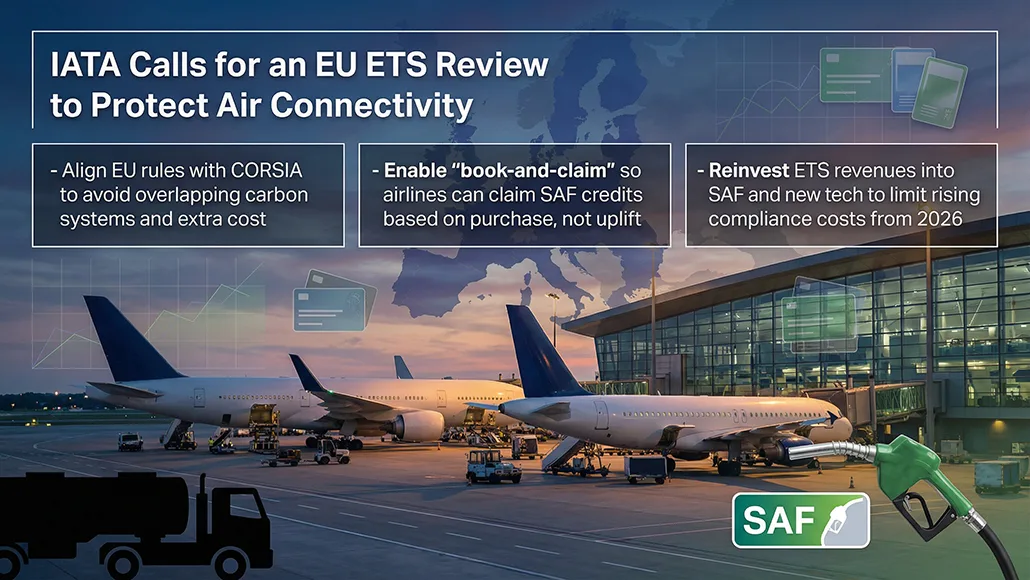
At the heart of IATA’s argument in this EU ETS review is the need to align European policy with global frameworks. Aviation operates across borders, and governments, including EU Member States, have already committed to a unified market-based mechanism under the International Civil Aviation Organization (ICAO), the Carbon Offsetting and Reduction Scheme for International Aviation (CORSIA). IATA stresses that the EU must implement CORSIA fully for all international flights, including intra-EEA routes, to avoid regulatory fragmentation. Overlapping regional and global systems, it argues, impose unnecessary administrative burdens and additional costs without delivering meaningful environmental benefits. A consistent and harmonized framework free from EU-specific eligibility criteria for Eligible Emissions Units (EEUs) would provide stability for airlines while ensuring credible and globally aligned emissions reductions.
Another key focus of the EU ETS review is accelerating the adoption of sustainable aviation fuel (SAF). IATA is calling for the introduction of purchase-based claiming under the EU ETS through a “book-and-claim” system. This mechanism would allow airlines to claim SAF credits based on purchase records rather than physical fuel uplift, offering flexibility and supporting a more transparent and liquid SAF market. To enable this, amendments to the EU ETS Directive are required, alongside the expansion of the Union Database to aircraft operators. Such measures would improve traceability, prevent double-counting, and promote equitable participation across regions, regardless of proximity to major fuel hubs.
The EU ETS review also addresses the growing financial burden on airlines following the 2024 phase-out of free allowances. IATA emphasizes that revenues generated under the system should be reinvested into the sector’s decarbonization efforts. Current mechanisms, such as the SAF Allowance scheme, cover only a small share, just 4-5% of total allowance needs between 2026 and 2030. With investment requirements projected at EUR 57 to 67 billion by 2035 and up to EUR 376 billion by 2050, the association argues for expanded support, including increased SAF allowances and targeted funding for emerging technologies and cost parity initiatives.
Ultimately, IATA warns that rising compliance costs under the EU ETS, particularly from 2026 onward, could weaken connectivity and reduce consumer choice. It maintains that a balanced approach combining global alignment, targeted investment, and cost management is essential to ensure both aviation decarbonization and Europe’s economic resilience.
