














The Shipping Association of Nigeria (SAN) has outlined the rationale behind the recent shipping tariff hike introduced by shipping line agencies in Nigeria, emphasizing that the decision followed an extensive regulatory review and aligns with current economic conditions. The clarification came in response to concerns raised by the National Association of Government Approved Freight Forwarders (NAGAFF) Trade Advocacy Committee, which had challenged the adjustment approved by the Nigerian Shippers’ Council (NSC). In a letter signed by SAN chairman Boma Alabi, the association acknowledged the objections but stated that some claims did not accurately reflect the regulatory procedures or the realities of international shipping operations in Nigeria. She stressed that the shipping tariff hike was neither a unilateral action by shipping lines nor an arbitrary regulatory decision.
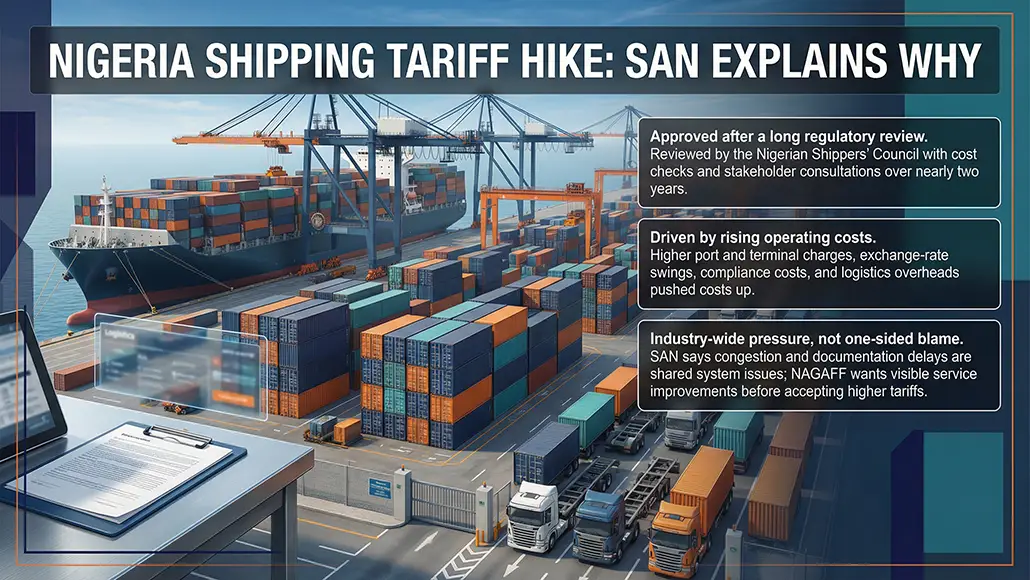
According to Alabi, the Nigerian Shippers’ Council undertook a comprehensive evaluation before approving the shipping tariff hike, including a detailed cost analysis submitted by shipping line agencies, consideration of inflation and foreign exchange volatility, and prolonged stakeholder consultations. She noted that the process spanned nearly two years and underwent multiple layers of regulatory scrutiny prior to approval. The adjustment, she explained, represents only a partial recovery of rising operational costs across the maritime sector and does not constitute a blanket increase for all operators. She further pointed out that the approved adjustment remains lower than Nigeria’s cumulative inflation rate over the same period. Key cost drivers cited include escalating port and terminal charges, compliance-related expenses, exchange rate fluctuations, and broader logistics and operational overheads.
Alabi also highlighted that the shipping tariff hike mirrors broader trends within the maritime and logistics industry, where various service providers such as truck operators, clearing agents, and terminal operators have increased their rates in response to economic pressures. She rejected suggestions of collective market dominance by shipping lines, asserting that the global liner shipping industry remains highly competitive, with companies independently setting freight prices and enhancing service delivery to attract cargo volumes. Addressing operational concerns raised by NAGAFF, she stated that issues such as port congestion, container return logistics, and documentation bottlenecks are systemic challenges involving multiple stakeholders, including port authorities, customs agencies, and logistics providers. She called for collaborative solutions rather than attributing responsibility to a single segment.
On regulatory concerns, Alabi dismissed references to laws such as the ICPC Act and the FCCPC Act as speculative and unsupported by formal findings, adding that shipping line agencies continue to operate under strict oversight and comply with statutory requirements. She reiterated that the shipping tariff hike was approved through due regulatory process and aims to sustain maritime services while ensuring fairness within the port system. Copies of SAN’s response were also sent to Pius Akutah and Abubakar Dantsoho.
Meanwhile, NAGAFF Trade Advocacy Committee Chairman Dr Increase Uche urged calm, stating that the association’s intervention seeks constructive reforms rather than conflict. He maintained that tariff increases must be supported by measurable improvements in service delivery, arguing that such progress has not been evident since the last adjustment about two years ago. He added that concerns remain over operational inefficiencies, including delays in container deposit refunds, while emphasizing that freight forwarders will continue to oppose the increase until these issues are addressed.
