

















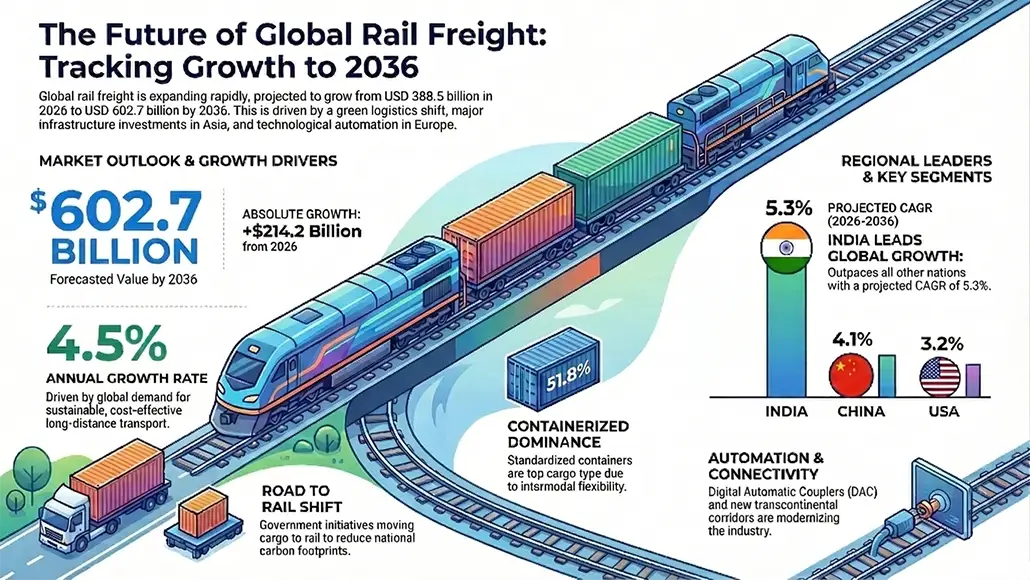
The global logistics landscape is undergoing a significant transformation as the demand for sustainable, cost-effective, and efficient transportation solutions intensifies. According to this comprehensive Rail Freight Market Report 2026, the sector is positioned for steady expansion over the next decade. The market, which was valued at $370 billion in 2025, is estimated to reach a valuation of $388.5 billion in 2026. Looking further ahead, the industry is projected to grow to $602.7 billion by 2036, representing an absolute dollar growth of $214.2 billion. This trajectory reflects a compound annual growth rate (CAGR) of 4.5% throughout the forecast period of 2026 to 2036.
Market Definition and Scope of Analysis
The rail freight market encompasses the transportation of goods and cargo via extensive railway networks. This includes the various associated services and logistics solutions utilized by shippers to move bulk, intermodal, and containerized freight across both regional and international corridors. The scope of this analysis includes freight types such as automotive and liquid bulk, service modes like door-to-door and terminal-to-terminal, and a wide array of end-use sectors including manufacturing, mining, agriculture, and retail. However, the forecast specifically excludes passenger rail services and road or air freight that is not integrated directly into rail logistics.
Core Drivers of Global Market Expansion
The growth identified in the Rail Freight Market Report 2026 is fueled by several macro-economic and environmental shifts. Efficiency and sustainability remain the primary catalysts. As governments worldwide implement stricter regulations to reduce carbon emissions, rail freight has emerged as a vital solution for long-distance transportation of heavy goods due to its lower carbon footprint compared to road transport.
Key demand drivers include:
- The Shift from Road to Rail: There is an increasing number of government initiatives aimed at shifting cargo from highways to railways to alleviate road congestion and meet environmental targets.
- Infrastructure Modernization: Significant investments in rail networks, particularly in emerging economies, are enhancing capacity and operational efficiency.
- Cost-Effectiveness for Bulk Cargo: Rail remains the backbone for moving heavy commodities like coal, minerals, and grain, offering lower unit costs and higher stability over long distances than competing modes.
- Integrated Supply Chains: Growth is increasingly shifting toward intermodal services that integrate rail with sea and road networks to serve e-commerce and time-sensitive manufactured goods.
Segmental Analysis: Dominant Services and Cargo Types
A critical aspect of the Rail Freight Market Report 2026 is the breakdown of market share by service and cargo types, which highlights where the most significant value is concentrated.
Service Type: Full Carload (FCL) Dominance
Full Carload (FCL) services are expected to maintain the largest market share, projected at 57.4% in 2026. FCL is highly favored by industries shipping large volumes of a single cargo type, such as agricultural products, raw materials, and coal. The primary driver for FCL is its streamlining of logistics for high-volume, long-distance transport, which optimizes costs for industrial supply chains.
Cargo Type: The Rise of Containerization
In terms of cargo, containerized freight is projected to dominate with a 51.8% market share by 2026. The shift toward containerization is driven by its inherent flexibility and ease of transshipment between different modes of transport, such as moving from a cargo ship to a railcar and then to a truck. This standardization reduces handling times and simplifies international trade logistics, especially for consumer goods and electronics.
Regional Market Outlook: 2026–2036
The Rail Freight Market Report 2026 highlights distinct growth patterns across various geographic regions, with Asia and North America leading in volume and infrastructure development.
South Asia and East Asia
- India: Leading the global market in growth, India is projected to have a CAGR of 5.3% through 2036. This is primarily driven by rapid industrialization and aggressive government infrastructure initiatives to enhance freight services.
- China: With a projected CAGR of 4.1%, China remains a dominant force. Its growth is supported by a massive expansion of rail networks and a strategic focus on improving logistics infrastructure for international trade.
- Japan: As a mature market, Japan exhibits a steadier CAGR of 2.2%, focusing on maintaining high efficiency for its existing freight solutions.
North America
- United States: The U.S. market is forecast to grow at a CAGR of 3.2%. The extensive scale of the existing rail network and the increasing demand for cost-effective, sustainable logistics solutions support this growth. A notable trend for 2026 is the focus on “nearshoring,” where rail is used to capture manufacturing traffic moving from Mexico to the Eastern U.S..
- Canada: Growing at a CAGR of 2.9%, Canada benefits from strong intermodal connectivity and increasing trade volumes with the United States.
Western Europe
- Germany: At a CAGR of 2.8%, Germany’s growth is fueled by continuous investment in European rail networks and a heavy emphasis on environmental sustainability.
- United Kingdom: The UK is projected to grow at 2.5% CAGR. A significant 2026 development includes a £15 million investment in the Barking Eurohub in London to restore regular cross-Channel intermodal freight, allowing direct rail exports to France, Germany, and Italy.
- France: Projecting a CAGR of 2.6%, France continues to develop its network and increase rail adoption for freight to meet sustainability goals.
Latin America
- Brazil: Showing a CAGR of 3.0%, Brazil’s market is expanding due to investments in long-distance rail infrastructure and the rising need for sustainable ways to transport industrial and agricultural goods.
Technological Innovation and Industry Shifts
The 2026 to 2036 forecast period marks a “decisive phase” for technological integration in rail freight. One of the most significant advancements is the commercial scaling of the Digital Automatic Coupler (DAC) in Europe. Extensive real-life commercial testing scheduled for 2026 aims to automate the coupling and uncoupling process while providing real-time digital monitoring of train integrity. This technology promises to drastically increase automation and operational safety.
Furthermore, the industry is seeing a shift toward intermodal logistics solutions. Companies are increasingly combining rail with road and sea freight to create more flexible and efficient supply chains. These value-added services often command higher yields and are essential for serving time-sensitive e-commerce sectors.
Strategic Implications for the Forecast Period
As the market moves toward a $602.7 billion valuation by 2036, several strategic priorities emerge for industry stakeholders:
- Sustainability as a Requirement: With rising regulatory pressure to reduce carbon footprints, adopting green rail solutions is no longer optional but a core competitive necessity.
- Infrastructure Investment: To capture growth, particularly in emerging markets like India and China, continued investment in upgrading rail corridors and terminal capacity is essential.
- Expansion of Intermodal Capabilities: Developing integrated logistics that connect rail seamlessly with other transport modes will be vital to meet the demand for flexible and fast freight delivery.
- Operational Automation: Embracing digital technologies like DAC and automated monitoring will be key to improving efficiency and reducing the long-term costs of rail operations.
Conclusion
The Rail Freight Market Report 2026 underscores a decade of robust opportunity anchored by a 4.5% CAGR. While traditional bulk cargo remains the market’s foundation, the future of growth lies in containerization, intermodal integration, and technological automation. Despite challenges such as infrastructure limitations and competition from other modes, the global push for “green logistics” and efficient long-distance transport ensures that rail will remain a vital backbone of the global economy through 2036.
