

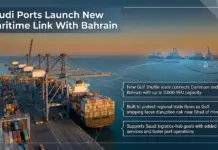


















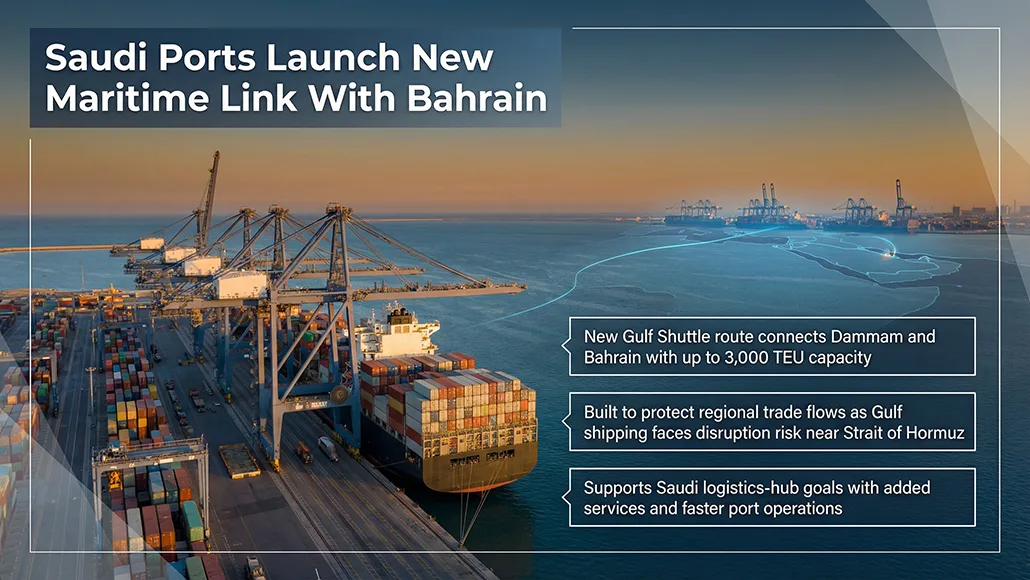
Saudi Ports Authority has introduced a new maritime link with Bahrain through MSC’s Gulf Shuttle service, as shipping lanes across the Gulf face mounting pressure from escalating tensions involving the U.S., Israel and Iran. Announced in a statement, the initiative, operated by the Saudi Ports Authority, known as Mawani, connects King Abdulaziz Port with Khalifa Bin Salman Port, providing capacity of up to 3,000 twenty-foot equivalent units. The new maritime link comes at a time when maritime traffic in the region is increasingly disrupted, particularly around the Strait of Hormuz, a vital chokepoint responsible for about one-fifth of global oil flows, which is currently constrained due to the ongoing conflict. Positioned within a wider strategy, the new maritime link aims to strengthen regional shipping integration, boost maritime connectivity, and expand logistics networks, reinforcing Saudi Arabia’s ambitions to serve as a global logistics hub linking Asia, Africa, and Europe.
King Abdulaziz Port in Dammam remains a cornerstone of the Kingdom’s trade infrastructure, with 43 berths and a handling capacity of up to 105 million tonnes of cargo and containers. The new maritime link is expected to sharpen the port’s competitive edge, streamline operations, and support national exports in alignment with the National Transport and Logistics Strategy. The development follows a series of initiatives by Mawani focused on enhancing supply chain resilience amid ongoing disruptions in the Strait of Hormuz. Earlier this week, five additional shipping services were introduced in collaboration with major global carriers, including Maersk and Hapag-Lloyd, bringing a combined capacity of 63,594 TEUs. Complementing these efforts, integrated maritime support services have also been rolled out across Eastern Region ports, covering bunkering, crew changes, and essential supplies to reduce delays and maintain vessel operations.
Separately, Saudi Arabia’s Transport General Authority has implemented a temporary waiver on documentation requirements for issuing and renewing marine navigation licenses and work permits for 30 days, with possible extensions. The move comes amid transport and supply disruptions in the Strait of Hormuz and reflects both recent geopolitical pressures and long-term planning.
