

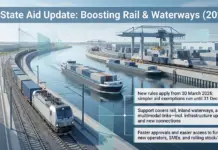










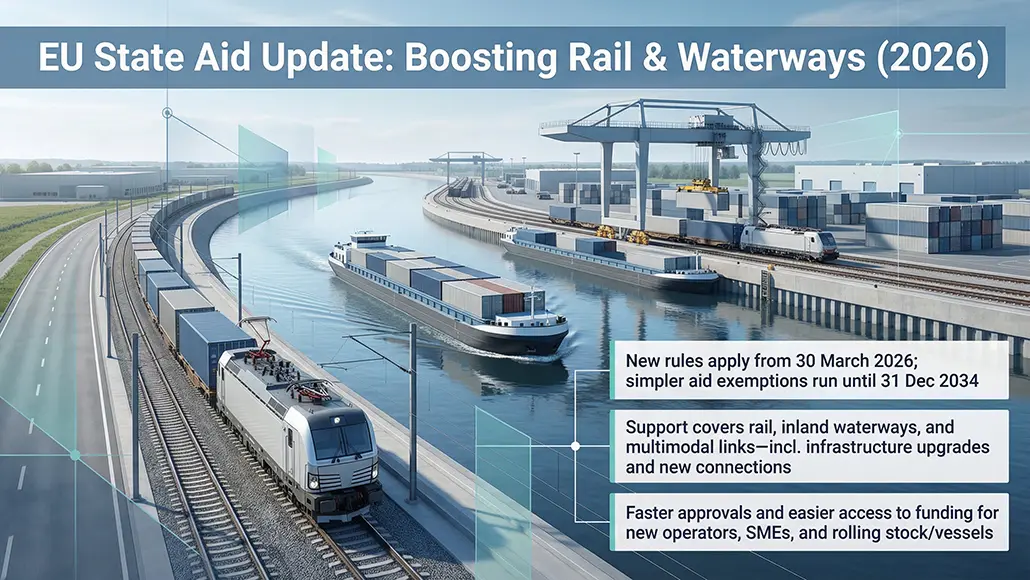
The European Commission adopted the State aid Land and Multimodal Transport Guidelines (LMT Guidelines) alongside the State aid Transport Block Exemption Regulation (TBER) on 16th March 2026. These guidelines are introducing an updated framework designed to boost rail and waterways across the European Union. These measures aim to encourage more sustainable transport options for both passengers and freight while modernizing the EU State aid system for land and multimodal transport. The rules are set to take effect on 30th March 2026, with the TBER remaining valid until 31st December 2034, while the LMT Guidelines have no fixed end date. Together, they replace the 2008 Guidelines on State aid for railway undertakings and establish a unified approach that supports efforts to boost rail and waterways while safeguarding competition.
The LMT Guidelines outline the conditions under which State aid must be notified to the Commission before approval and define when such support can be considered compatible with the internal market. The guidelines apply to transport modes deemed more sustainable than road, including rail, inland waterways, and multimodal systems that incorporate at least one of these modes or combine land transport with short sea shipping. The framework clarifies how operating and investment aid can be used, including funding for railway infrastructure upgrades, inland waterway facilities, and the launch of new commercial connections. It also addresses reimbursement mechanisms for public service obligations in the rail freight sector. By introducing greater flexibility, the Guidelines support initiatives that directly contribute to environmental and digital objectives, further helping to boost rail and waterways while reducing external transport costs and improving interoperability across national rail systems.
In parallel, the TBER simplifies the process for granting aid by exempting certain categories from the need for prior notification and approval. This allows Member States to act more quickly when conditions are met, aligning with the Commission’s goal of reducing administrative burdens while delivering faster outcomes. The regulation closely reflects the structure and scope of the LMT Guidelines, ensuring consistency across both instruments. The combined framework is also designed to support market entry and expansion by new operators, facilitating access to financing for SMEs, small- and mid-caps (SMCs), and emerging players seeking to invest in rolling stock or inland waterway vessels, thereby contributing to efforts to boost rail and waterways.
The adoption of these measures follows a series of evaluations and policy steps. The 2019 Fitness Check highlighted the effectiveness of earlier Railway Guidelines in encouraging a modal shift and promoting interoperability, while also identifying the need for updates. Subsequent milestones included the publication of an inception impact assessment in October 2021, the Council’s Enabling Regulation in December 2022, and a call for evidence and public consultation in March 2024 regarding LMT guidelines and TBER. These processes have culminated in a revised framework intended to boost rail and waterways and align transport policy with evolving market and technological developments.
