





















The modern transport industry operates within a complex framework of safety regulations and legal requirements designed to protect both drivers and the general public. Central to this framework is the ability to accurately record and monitor the activities of professional drivers. The transition from manual paper-based logs to sophisticated electronic recording devices has fundamentally changed the landscape of the industry. Today, the integration of digital tachographs and fleet compliance systems represents the gold standard for maintaining operational integrity and ensuring that transport businesses remain on the right side of the law.
For a commercial operator, compliance is not merely a box-ticking exercise; it is the bedrock of a safe and professional business. The risks associated with non-compliance—ranging from heavy fines and legal action to the loss of an operator’s license—are too great to ignore. Digital tachograph technology provides a level of accuracy and transparency that was previously impossible, allowing managers to identify and address potential issues before they escalate into serious violations. In an era of increasing road density and high-pressure delivery schedules, these systems are essential tools for managing the human element of the logistics chain.
The Evolution of Smart Tachograph Technology
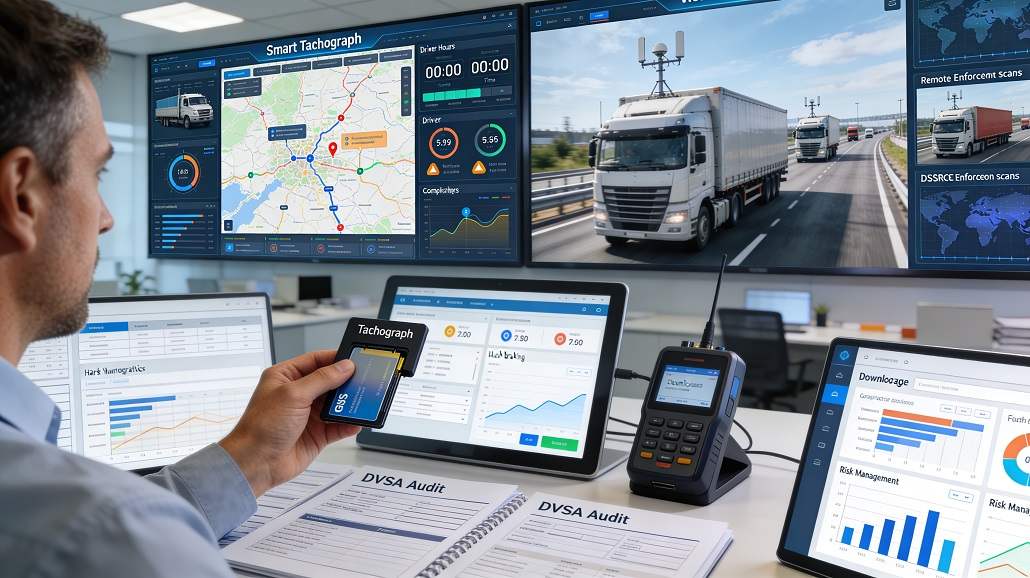
The introduction of the “Smart” or “Generation 2” digital tachograph marks a significant leap forward in transport technology. These advanced devices are equipped with integrated GNSS (Global Navigation Satellite System) modules that automatically record the vehicle’s location at the start and end of the working day, as well as every three hours of accumulated driving. This automation significantly reduces the administrative burden on the driver and virtually eliminates the risk of accidental manual entry errors. Furthermore, the inclusion of DSRC (Dedicated Short-Range Communication) technology allows enforcement authorities to perform remote checks on moving vehicles, identifying potential infringements without the need for a time-consuming roadside stop.
While the idea of “remote enforcement” may seem daunting to some, it actually benefits compliant operators by reducing unnecessary interruptions to their schedule. By providing a clear and tamper-proof record of activities, smart tachograph technology rewards those who adhere to the rules. It also serves as a powerful deterrent against the minority of operators who might seek an unfair competitive advantage through illegal working practices. The result is a more level playing field for the entire industry, where safety and legality are the primary metrics of success.
Fleet Compliance Software and Data Analytics
The true power of the digital tachograph is realized when it is paired with robust fleet compliance software. Collecting the data is only the first step; the real value lies in the analysis. Modern software platforms can automatically download data from both the vehicle and the driver card, cross-referencing it against complex driver hours regulations to identify potential infringements in real-time. This proactive approach allows fleet managers to provide targeted coaching and training to drivers, addressing behaviors like “harsh braking” or “unauthorized idling” alongside more serious hours-of-service violations.
A well-integrated transport compliance management system also simplifies the process of reporting and record-keeping. In the event of an audit by regulatory bodies like the DVSA (Driver and Vehicle Standards Agency), having organized, digital records can be the difference between a minor recommendation and a major penalty. These systems provide a “single source of truth” for the entire organization, ensuring that everyone from the dispatch office to the boardroom has visibility into the fleet’s compliance status. This transparency is vital for building a culture of accountability and ensuring that safety remains the top priority.
Managing Driver Hours Regulations and Fatigue
The primary purpose of any tachograph system is to enforce driver hours regulations. These rules are grounded in the understanding that fatigue is one of the most significant risk factors in the transport industry. Managing a driver’s working time manually is a difficult and error-prone task, especially when dealing with the complexities of double-manning, ferry crossings, and varying weekly rest requirements. Digital tachographs and fleet compliance systems provide a clear, unambiguous record of every minute spent driving, working, and resting.
For the driver, the system provides a clear countdown of their remaining driving time, helping them to plan their rest breaks more effectively and avoid accidental “over-runs.” For the company, it provides the data needed to plan routes and schedules that are both efficient and legal. By using tachograph data to inform operational decisions, businesses can ensure that they are not making unrealistic demands on their staff. This not only improves road safety but also enhances driver well-being and retention, as employees feel supported in their commitment to working safely and legally.
Strengthening Fleet Risk Management and Safety Audits
Compliance is an integral component of a broader fleet risk management strategy. Every infringement, no matter how small, is a potential liability that can impact insurance premiums and the company’s reputation. By maintaining a consistently high standard of compliance, operators can demonstrate to insurers and clients that they are a “low-risk” partner. This can lead to significant financial savings and provide a competitive edge when bidding for high-value contracts with safety-conscious corporations.
Regular fleet safety audits are essential for maintaining these high standards. These audits involve a deep-dive into tachograph records, vehicle maintenance logs, and driver training files. Digital systems make this process much more efficient and reliable. Instead of sifting through boxes of paper, auditors can use software to run automated checks and identify any gaps in the records. This allows the company to continuously improve its processes and stay ahead of changes in road transport law. Compliance is a continuous journey of improvement, not a destination.
The Human Element in a Digital Ecosystem
While the technology is sophisticated, the human element remains the most important factor in any compliance system. Drivers are the ones on the front line, and their understanding and cooperation are vital for the system to work. This requires a commitment to ongoing training and clear communication of the “why” behind the rules. When drivers understand that the digital tachograph is there to protect their safety and the reputation of the company, they are much more likely to embrace it as a positive tool.
A supportive compliance culture is one where errors are used as a basis for education rather than just an occasion for punishment. Of course, deliberate tampering must be dealt with firmly, but many infringements are the result of a simple misunderstanding of the complex regulations. By providing drivers with the support they need to succeed, companies can build a professional and loyal workforce. This human-centered approach is what turns a set of technical requirements into a genuine culture of excellence and safety.
Future Trends in Transport Compliance Management
As we look toward the future, the integration of digital tachographs and fleet compliance systems will only become deeper and more intelligent. We are already seeing the emergence of “predictive compliance” models, where AI algorithms are used to identify drivers who may be at risk of an infringement based on historical patterns of behavior or even data from driver fatigue monitoring systems. By intervening early, companies can prevent violations and further enhance road safety.
Furthermore, the move toward autonomous and semi-autonomous vehicles will require a rethinking of how “driving time” is recorded. How do we account for the time spent monitoring an automated system? These are the questions that regulators and industry leaders are currently addressing. Whatever the future holds, the core principles of the digital tachograph accuracy, transparency, and accountability will remain the foundation of a safe and professional transport industry. The digital tachograph is not just a recording device; it is a gateway to a safer and more efficient future for global logistics.
