
















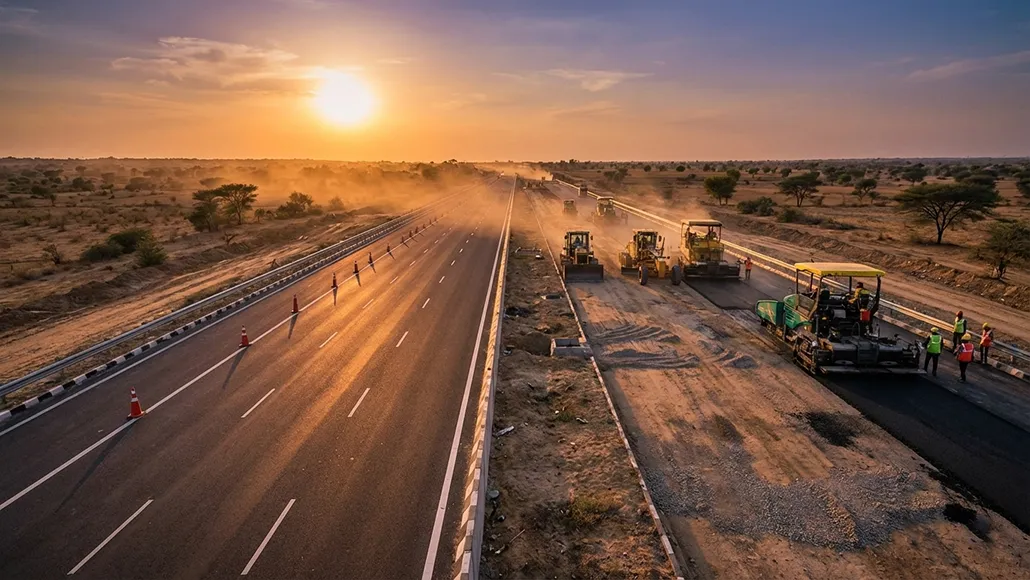
For a growing economy like India, it does not come as a surprise when we say that it is working to attract private capital back in highway construction. This step comes to the fore a decade after investors walked away with concerns related to revenue risks and also bureaucratic delays.
The Indian government is coming up with new rules that go on to promise revenue protection for developers and also invite global funds in order to bid for projects to speed up the expressway expansion, said the people familiar with the matter.
The model is most likely to get finalized in February 2026 itself, and the objective is to award projects amounting to ₹1 trillion, or $11 billion, to the private sector through the 2027 fiscal year.
It is well to be noted that Prime Minister Narendra Modi’s government with private capital back in highway construction, wants the private investment to account for almost 25% of highway development by 2027, vis-à-vis the present low single digits. The fact is that till now, the private capital has largely avoided the sector for the last decade, forcing the administration to depend pretty heavily on public funds in order to bridge the infrastructure gaps.
In the recent budget, India has gone on to announce infrastructure spending of ₹12.2 trillion for the next financial year, which, apparently, is a 9% increase from 2025. Outlays for roads and bridges are going to rise by 6.9% to ₹3.1 trillion.
Notably, India’s push to resurrect private investment in highways can be termed as a part of a much wider effort to expand corporate participation throughout infrastructure. The government is transitioning towards privatizing the loss-making airports through bundling them with profitable ones so as to attract bidders and is also encouraging foreign partnerships when it comes to shipbuilding. Put together, all these efforts signal toward a coordinated strategy in order to reach out to more private funds in sectors that have long been supported by public spending.
Interestingly, the highway sector of India, at one point in time, attracted major private investment by way of Build-Operate-Transfer – BOT-Toll model, wherein the developers recovered expenditures through toll collections at the time of concession periods. Interest when it comes to this model has diminished. Apparently, between April and November 2025, just 1% of projects were awarded under the BOT-Toll. Rather, the government-backed Hybrid Annuity Model, along with Engineering, Procurement, and Construction contracts, comprised 99% of the 26,425 kilometers of roads that were awarded.
Industry Challenges
Interestingly, the new norms are customized so as to address industry grievances, which include delays when it comes to mandatory approvals along with competition coming from parallel road projects, which has also eroded toll revenues. Through allowing investment funds to go ahead and participate directly, India is going to sync itself with global practices wherein the financial investors can bid for projects and thereafter bring in technical partners for implementation.
There is no exaggeration when we state that the renewed push as far as private capital is concerned is intended to modernize the infrastructure and decrease the logistics costs in addition to strengthening the competitiveness of the country against China.
The government looks forward to expanding the high-speed network five times within a matter of 10 years, backed by a planned investment worth ₹11 trillion.
In order to further push investor confidence, the government is going to also set up an Infrastructure Risk Guarantee Fund, confirmed the Finance Minister of India, Nirmala Sitharaman, during her speech on this year’s budget.
Deloitte India estimates suggest that the country is most likely to attract billions of dollars when it comes to infrastructure investment in the next three years.
