



















The operation of heavy vehicles on public roads is a task of immense responsibility, requiring a high level of skill, concentration, and situational awareness. Given the sheer size and weight of these vehicles, the consequences of a momentary lapse in judgment or a failure to see a hazard can be catastrophic. Historically, road safety in the trucking industry relied almost entirely on the experience and vigilance of the person behind the wheel. However, as traffic density increases and delivery schedules become more demanding, the industry is turning to technology to provide a critical safety net. The deployment of advanced driver assistance in heavy vehicles has emerged as one of the most effective ways to reduce accidents, protect lives, and ensure long-term operational resilience. These systems represent the convergence of advanced sensor technology, powerful computing, and intelligent software to create a safer road environment for everyone.
Advanced Driver Assistance Systems, or ADAS, represent a suite of electronic technologies designed to assist the driver in the complex task of navigating a large vehicle through a dynamic environment. These systems are not intended to replace the driver; rather, they serve as an “extra pair of eyes” that never gets tired, distracted, or stressed. By integrating a range of sensors including radar, lidar, and high-definition cameras these systems can monitor the vehicle’s surroundings in real-time and intervene when a dangerous situation is detected. This proactive intervention is a fundamental change from the reactive safety measures of the past, marking a new era of intelligence in transport safety.
The Evolution of ADAS for Trucks
The journey of ADAS for trucks began with relatively simple features that many now take for granted, such as anti-lock braking systems (ABS) and electronic stability control (ESC). While these were revolutionary at the time, they were primarily reactive, intervening only after a loss of control had already begun. The new generation of advanced driver assistance in heavy vehicles is far more proactive. Modern commercial vehicle safety systems are designed to perceive hazards long before they result in a collision, providing the driver with the precious seconds needed to take corrective action. This shift from “mitigation” to “prevention” is the core mission of modern safety technology.
One of the most impactful features of modern ADAS is Autonomous Emergency Braking (AEB). This system continuously monitors the distance and relative speed of the vehicle ahead using a combination of radar and camera data. If it detects a high risk of a rear-end collision and the driver fails to respond to multiple levels of warnings, the system can automatically apply the brakes to either avoid the impact or significantly reduce its severity. For a vehicle weighing up to 44 tonnes, the ability to shave even a few miles per hour off the impact speed can mean the difference between a minor incident and a fatal tragedy. The reliability of these systems is such that they are now a mandatory requirement for new vehicle registrations in many jurisdictions.
Sensor Fusion and the “Digital Shield”
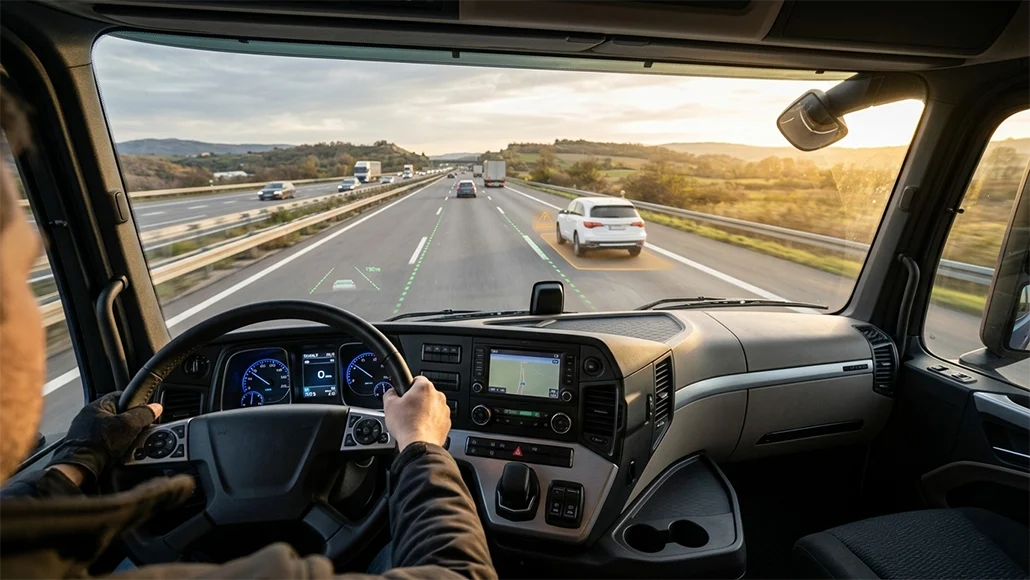
The effectiveness of advanced driver assistance in heavy vehicles depends on “Sensor Fusion” the ability of the vehicle’s computer to combine data from different types of sensors to create a single, accurate picture of the environment. While radar is excellent for measuring distance and speed in all weather conditions, cameras provide the necessary detail to identify specific objects like pedestrians, cyclists, and traffic signs. By fusing this data, the system can make much more reliable decisions than it could using any single sensor alone. This creates a “digital shield” around the truck, providing 360-degree awareness that far exceeds the capabilities of a human driver using mirrors alone.
This digital shield is particularly important during complex maneuvers, such as merging onto a highway or navigating a busy intersection. Lane Departure Warning (LDW) and Lane Keeping Assist (LKA) use cameras to monitor the vehicle’s position relative to road markings. If the truck begins to drift out of its lane without a turn signal, the system can provide an alert or even apply gentle steering inputs to bring the vehicle back to the center of the lane. This technology is particularly effective at preventing accidents caused by fatigue or distraction, two of the leading causes of long-haul trucking incidents.
Enhancing Situational Awareness and Blind Spot Monitoring
One of the greatest challenges for any truck driver is the existence of significant blind spots around the vehicle. Despite the best efforts of mirror manufacturers, there are still areas particularly on the passenger side and directly behind the trailer where a cyclist or a small car can virtually disappear. Advanced driver assistance in heavy vehicles addresses this through sophisticated blind-spot monitoring and side-guard assist systems. These technologies use ultrasonic or radar sensors to detect the presence of vulnerable road users in the vehicle’s blind spots.
When the driver activates a turn signal and a hazard is detected in the blind spot, the system provides both visual and audible warnings. In some advanced versions, the system can even apply the brakes if it senses that a collision with a cyclist or pedestrian is imminent during a low-speed turn. This is particularly crucial in dense urban environments where heavy trucks and vulnerable road users frequently share the same road space. By effectively “seeing” what the driver cannot, these systems provide a level of protection that is essential for modern urban logistics. The reduction in “sideswipe” accidents alone provides a compelling return on investment for fleet safety solutions.
Driver Monitoring Technology and Fatigue Management
Safety is not just about what is happening outside the vehicle; it is also about the state of the person inside. Driver fatigue and distraction are well-documented risk factors in the transport industry, often exacerbated by long hours and the monotony of motorway journeys. This is where driver monitoring technology comes into play. Inside the cab, specialized infrared cameras and sensors monitor the driver’s facial expressions, eye movements, and head position. This system operates in all lighting conditions and can even “see” through sunglasses to track pupil movement.
If the system detects signs of drowsiness such as long blinks, frequent yawning, or the head beginning to droop it can trigger an immediate alert. Some systems even monitor steering inputs; if they detect the erratic patterns associated with a micro-sleep, they can provide a haptic warning through the steering wheel or seat. By identifying fatigue in its early stages, advanced driver assistance in heavy vehicles allows the driver to recognize their condition and find a safe place to stop before an accident occurs. This focus on the “human factor” is a vital part of any comprehensive safety strategy, ensuring that the driver remains the most capable part of the system.
Navigating Road Safety Compliance and Regulation
Beyond the moral imperative to protect life, the adoption of ADAS is increasingly driven by a complex web of road safety compliance and regulation. Governments are recognizing the efficacy of these technologies and are making them mandatory. In the European Union, the General Safety Regulation (GSR) mandates features like intelligent speed assistance and advanced emergency braking for all new trucks. For fleet operators, staying ahead of these regulations is essential for maintaining their “license to operate.” A fleet equipped with the latest commercial vehicle safety systems is less likely to be involved in accidents that lead to costly litigation and insurance premium hikes.
Furthermore, the data generated by these systems can be used to demonstrate a commitment to safety during regulatory audits. Telematics platforms can record every “near-miss” or ADAS intervention, providing a clear picture of the fleet’s safety profile. This data-driven approach to compliance allows managers to identify high-risk routes or behaviors and take proactive steps to address them. In many cases, insurance providers now offer lower premiums or “safety grants” for vehicles equipped with specific ADAS features, providing a direct financial incentive to invest in the latest safety technology.
The Bridge to Autonomous Truck Features and V2X
While we are not yet at the stage of fully driverless heavy vehicles on public roads, the ADAS features we see today are the building blocks of future autonomy. Technologies like adaptive cruise control and lane-keeping assist are essentially “Level 2” autonomous truck features. They handle specific aspects of the driving task, allowing the driver to focus on broader situational awareness. The next step in this evolution is “Vehicle-to-Everything” (V2X) communication, where the truck can “talk” to traffic lights, other vehicles, and even road sensors to gain information about hazards that are far beyond the reach of its own on-board sensors.
Imagine a truck receiving a signal from a bridge several miles ahead that there is black ice on the road, or a traffic signal informing the truck of its timing so it can adjust its speed to catch a “green wave.” This level of connectivity will transform ADAS from a localized safety tool into a part of a global, intelligent transport network. As these systems become more integrated, the safety and efficiency of the entire transport sector will reach new heights. Every truck equipped with advanced driver assistance in heavy vehicles today is a contributor to this safer and more efficient future.
Key Takeaways
Proactive Hazard Mitigation and Sensor Fusion
Advanced driver assistance in heavy vehicles shifts the safety paradigm from reactive to proactive. By utilizing sensor fusion combining radar, camera, and lidar data the technology provides a “digital shield” that compensates for human limitations. Features like Autonomous Emergency Braking and Blind Spot Monitoring effectively reduce the frequency and severity of accidents, providing a critical safety net in an increasingly demanding logistics environment.
Integrating Human and Machine Intelligence
The most effective fleet safety solutions are those that combine driver monitoring technology with external sensing capabilities. By addressing both the environmental hazards outside the cab and the physiological state of the driver inside, ADAS creates a comprehensive safety ecosystem that enhances performance while maintaining strict road safety compliance. As the technology evolves toward V2X and higher levels of autonomy, these systems will become the foundation of a global, intelligent, and accident-free transport network.
