






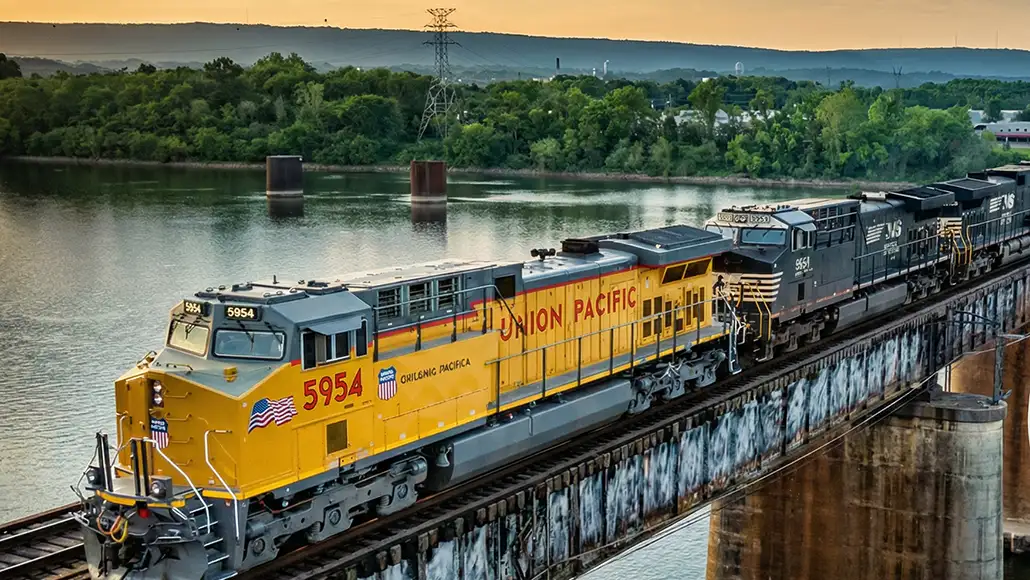
Union Pacific and Norfolk Southern, in December 2025, went on to submit a comprehensive application to the Surface Transportation Board, thereby requesting approval to merge the two major freight railroads into what would then go on to become the first transcontinental railroad in America. The filing goes on to represent a landmark moment when it comes to American transportation history, proposing the creation of a unified rail network that spans the nation from coast to coast. The almost 7,000-page application offers extensive details on how this end-to-end combination is likely to elevate competition in the freight industry while at the same time delivering substantial public benefits to customers, employees, and, of course, communities throughout the country. The companies first executed the merger agreement, in which UP will acquire NS, on July 29, 2025, thereby setting the stage for this regulatory filing. Interestingly, both companies expect the merger to be completed by early 2027, pending the regulatory review and approval in the statutory timeline that has been established by the STB.
It is well to be noted that the proposed Unified Rail Network would help unite the expansive western reach of Union Pacific with that of Norfolk Southern’s access when it comes to eastern manufacturing as well as population centers. Union Pacific at present operates throughout 23 western states. Norfolk Southern functions as a 22-state network within the eastern United States, having connections across every major container port when it comes to the Atlantic coast and also other major ports throughout the Gulf Coast as well as the Great Lakes. The combined entity is going to help create a network that will have 50,000 route miles across 43 states and also over 100 ports. Jim Vena, the Union Pacific chief executive, stresses the significance of the merger in terms of adapting to the changing demands in freight delivery, stating that as the time and technology continue to grow and also transform how freight gets delivered, the industry has to keep pace and also move forward, hence reaching the underserved markets with new rail solutions and also strengthening the United States supply chain. Vena went ahead and expressed confidence that the customers deserve more robust, more connected freight rail, and the merger is going to deliver just that.
Mark George, the Norfolk Southern president and CEO, underscored the complementary nature of both the networks, explaining that this combination is going to bring together the expansive western reach of Union Pacific and access to eastern manufacturing and population centers in an end-to-end combination by Norfolk Southern. The outcome is going to be a unified rail system that is capable of bridging the gap between east and west, enabling the freight to bypass the congested interchanges and also take the fastest as well as the most efficient, and price-competitive route. The Union Pacific-Norfolk Southern combination goes on to represent a classic end-to-end merger, with each railroad at present serving very varied geographic regions and having complementary networks, customers, and markets. Unlike the mergers that might go on to decrease the competition through combining overlapping services, this transaction is going to connect both the systems that have historically gone on to operate independently within their respective territories.
One of the most prominent operational enhancements that has been promised by the merger goes on to involve the transformation of interline service into a single-line service. At present, shipments that move across the country have to be handed off between railroads, thereby making way for delays and inefficiencies. The combined company would go ahead and convert 10,000 present lanes from the interline service needing time-consuming handoffs into much faster and more efficient single-line service. This enhancement would eliminate approximately 2,400 rail cars and container handling, as well as reduce 60,000 car-miles each day, thereby significantly improving the speed and reliability of transcontinental freight movement. The companies go on to point to the research demonstrating that when the single-line rail service is available, the share when it comes to freight traveling through rail as against the highway is almost two to three times more than with the interline service. This finding goes on to suggest that creating an easy transcontinental network would fundamentally alter the competitive dynamics between rail and trucking, especially for long-haul freight movements.
The merger application goes on to outline many advantages that customers would get from the combination. Quicker, more efficient service goes on to represent the cornerstone of customer advantages, with the integration going ahead and creating another 84,000 county-to-county lanes where the shippers at present moving freight by road could, for the very first time, make use of single-line rail service. This sort of expansion of service alternatives would go on to offer shippers alternatives that they never had access to. The combined railroad has also gone ahead and announced plans to introduce many new routes as part of its optimized operating plan. Both the new daily intermodal train pairs are going to connect the east and west with further direct service, hence decreasing the estimated transit times from Southern California to the Ohio Valley and also the Northeast by around 20 hours. Service from Southern California to the Southeast would also witness transit time reductions of over two days. Moreover, the six new manifest trains would come to the fore so as to bridge the east-west divide in a more efficient way, hence reducing more than 600 daily car handlings. In order to meet the expected intermodal growth, the combined company looks forward to coming up with a total of six premium intermodal lanes that operate seven days a week.
Interestingly, customers who own railcars would benefit from the enhanced productive usage of their assets. Due to much faster and more predictable service, customers can turn the cars more quickly, lessen the idle time, and also lower the equipment expenditures. The unified digital experience promised by way of the merger is going to allow the shippers to go ahead and integrate scheduling and monitoring, as well as shipment visibility, by way of a single platform. Customers would get that benefit from having just one commercial team, one contract, and one invoice, as well as one accountable partner for their overall rail journey. The application goes on to introduce Committed Gateway Pricing, which is a voluntary enhancement that is designed in order to further the competition by ensuring to streamline the pricing of interline moves for thousands of customer locations that otherwise may not directly benefit from the merger. The combined company would go on to keep all the present gateways open for the eligible traffic on terms that are commercially reasonable. As an added safeguard measure for customers, Union Pacific is going to voluntarily create a separate dispute resolution program in order to efficiently address certain claims with regard to merger-related service issues.
It is well to be noted that short-line railroads would also benefit from the merger. As Union Pacific and Norfolk Southern go on to create new single-line routes, open competitive markets, and also streamline the service, short lines are all set to capture the new volumes that would flow directly onto their rails, hence potentially spurring the growth all across the regional rail network. The unified rail network is going to offer efficient, agile, and dependable single-line access to over 100 ports, thereby connecting to international markets and also 10 global gateways to markets across Canada as well as Mexico. This elevated connectivity is going to strengthen the American businesses’ position in international trade and also enhance the resilience when it comes to the national supply chain. Rail transportation already goes on to represent the most sustainable way to move freight over ground. The merger would further elevate these environmental advantages by way of multiple mechanisms. Eradicating almost 2 million trucks from the road per year would directly help decrease the transportation-related emissions. The combined company is also going to be positioned to run trains in a more efficient way, invest in cleaner as well as better technologies, and also offer customers better tools in order to attain their own sustainability objectives.
The application also addresses the workforce considerations and has commitments designed to protect the railroad employees. The companies pledge that each and every employee who has a union job at the time of the merger is going to continue to have one following the merger. Union Pacific has also gone ahead and formalized the groundbreaking jobs-for-life agreements with multiple unions, hence offering unmatched job security for the represented workers. Any merger-related union job efficiencies are going to be achieved solely by way of attrition rather than layoffs. Beyond the job protection, the companies anticipate the combined entity to grow by way of creating almost 900 net new union jobs by the third year post the merger to handle the anticipated growth in volume.
Safety still goes on to remain the highest priority for both the railroads, and the application does have a comprehensive safety integration plan, which is developed in collaboration with the Federal Railroad Administration and has been submitted to the STB. The plan draws a picture of how the new company will combine best practices from each railroad to further elevate the safety outcomes. The companies are hoping to invest an estimated $2.1 billion of the incremental capital so as to integrate both the systems and also deliver real-time advantages to customers. Notably, the application on this Unified Rail Network is now subject to a 30-day review by the STB for its completeness. The formal assessment could take a year or even longer. Following the approval, the combined company is going to continue to operate as per the ongoing STB oversight.
