





















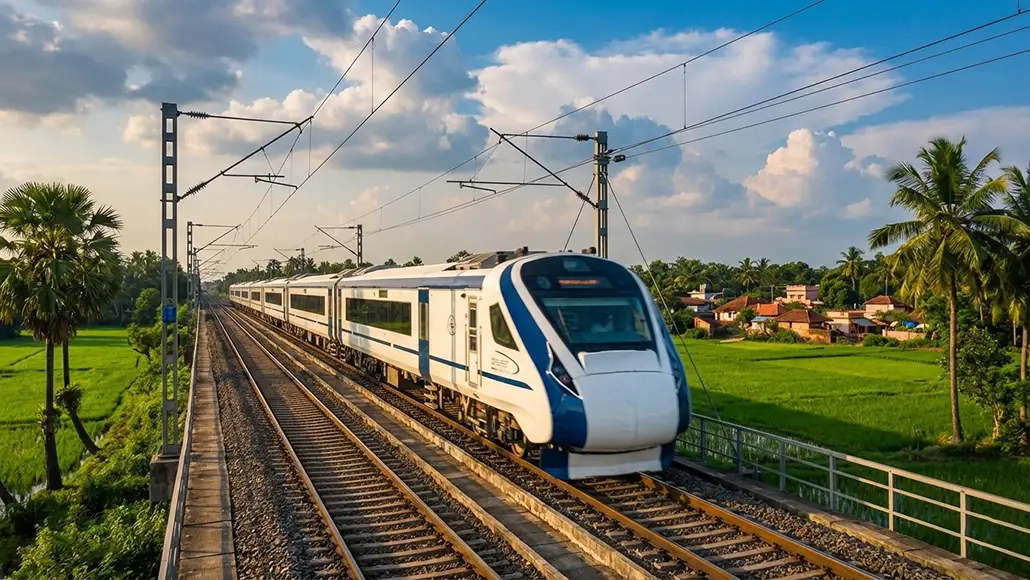
The Indian government is working on a new Indian Rail Tech policy aimed at throttling local manufacturing when it comes to advanced railway technology and equipment, reported The Economic Times.
What is it about?
As per the report, the new Indian Rail Tech policy is most likely to get announced in the coming few weeks. As per the plan, the Railway Board is most likely to offer partial funding, technical aid, and also access to the testing centres.
All this that is done is part of the efforts by the government so as to modernize the rail network and at the same time decrease the dependence on imports, mostly from China.
The reason it matters
India, apparently, is still importing massive amounts of railway equipment. Most of the imports that are referred to here are not full trains, but they are in parts and subsystems, such as locomotive components along with rolling stock pieces, which get assembled in India. But all of it highlights the dependence of India on its foreign suppliers when it comes to key technology.
Interestingly, in 2024-25, India imported railway and tramway locomotives along with rolling stock and also related equipment worth almost ₹6,098 crore. The fact is that some of the top importers when it comes to rolling stock parts included the likes of China, Austria, the Czech Republic, and Germany, as well as the US.
It is China that still remains the biggest supplier, offering equipment like wheel sets, bogies, and general mechanical parts. As per the data from the World Integrated Trade Solution, India went on to import 1,475,240 kilograms of rolling stock parts from China, which was followed by 922,007 kg from Germany, 720,147 kg from the Czech Republic, and 637,992 kg from Austria.
Notably, Germany and Austria are prominent sources of high-precision engineering products, specifically the suspension and braking systems, which are used in the modern coaches. On the other hand, the US and Japan supply advanced technologies like diesel propulsion components along with signalling systems.
The new policy looks forward to reducing the dependence on foreign suppliers and creating certain robust domestic capacities.
Are there any other similar schemes running?
The Economic Times report, which cited an official, stated that the policy is indeed going to offer a fresh thrust when it comes to innovation in mass transport. It is anticipated to boost the Indian companies to work in close proximity with research institutions.
It is worth noting that the latest plan follows the past Indian Railway Innovation Policy, which was launched in June 2022. That scheme offered almost ₹1.5 crore in 50:50 grant support to startups along with small firms in order to develop prototypes that are operational. It went on to focus more on safety and efficiency along with maintenance and also gave innovators the ownership when it came to their ideas, access to safe testing scenarios, and also assured procurement if the solutions went on to prove successful and also cost-effective.
Investment boost for railways
The fact is that the Indian government is actually raising its spending on railways. In the FY27 Budget, ₹52,108 crore is allocated for capital expenditure when it comes to rolling stock, which goes well beyond the ₹50,007 crore that is allocated for the present financial year.
Eventually, the money is going to be used to buy new locomotives, coaches like Vande Bharat train sets, and also wagons as part of the modernization of the fleet. Ashwini Vaishnaw, the Indian Railways minister, recently remarked that India looks forward to being completely self-reliant in developing seven newly announced bullet train networks.
In the end
This upcoming Indian Rail Tech policy is indeed a part of the Indian government’s broader strategy in order to go ahead and strengthen domestic manufacturing, decrease the dependence on foreign parts, and also speed up the modernization in railways. It is likely to enable the country to create certain advanced rail systems having more technology that is developed and produced locally.
