












The heavy-duty transport sector has long been considered one of the most difficult segments of the global economy to decarbonize. Unlike passenger cars or light-duty vans, heavy goods vehicles (HGVs) operate under extreme demands, requiring immense power to move heavy loads over long distances with minimal downtime. For decades, diesel has been the undisputed king of this domain, prized for its high energy density and the convenience of a global refueling network. However, as the climate crisis intensifies and governments around the world commit to legally binding net-zero targets, the industry is entering a period of rapid transition. The rise of zero emission HGVs and fleet decarbonisation is now the primary focus for manufacturers, logistics providers, and policymakers alike. This is not just a change in technology; it is a wholesale reconstruction of the global freight energy system.
The challenge is not merely technical; it is structural and systemic. Decarbonizing the heavy freight industry requires a complete reimagining of the energy systems that power our economies. We are moving away from a centralized model of fossil fuel distribution toward a more fragmented and complex landscape of electricity and hydrogen. This shift is being driven by a combination of technological breakthroughs, declining costs of renewable energy, and a growing recognition that the “business as usual” approach to freight transport is no longer sustainable. The transition involves a massive investment in new vehicle architectures, refueling infrastructure, and the underlying electrical and gas networks that will support them.
The Dual Path: Electric and Hydrogen Solutions
When discussing zero emission HGVs and fleet decarbonisation, the conversation typically centers on two primary technologies: battery-electric vehicles (BEVs) and hydrogen fuel cell electric vehicles (FCEVs). Each has its own set of advantages and limitations, and it is increasingly clear that both will play a vital role in a balanced low carbon freight ecosystem. For shorter-haul regional distribution and urban deliveries, electric heavy duty vehicles have already proven their viability. The high efficiency of electric motors, combined with the ability to charge at depots during mandatory driver rest periods, makes them a practical solution for many duty cycles. The simplicity of the electric drivetrain also reduces maintenance costs, making the “total cost of ownership” increasingly competitive with diesel.
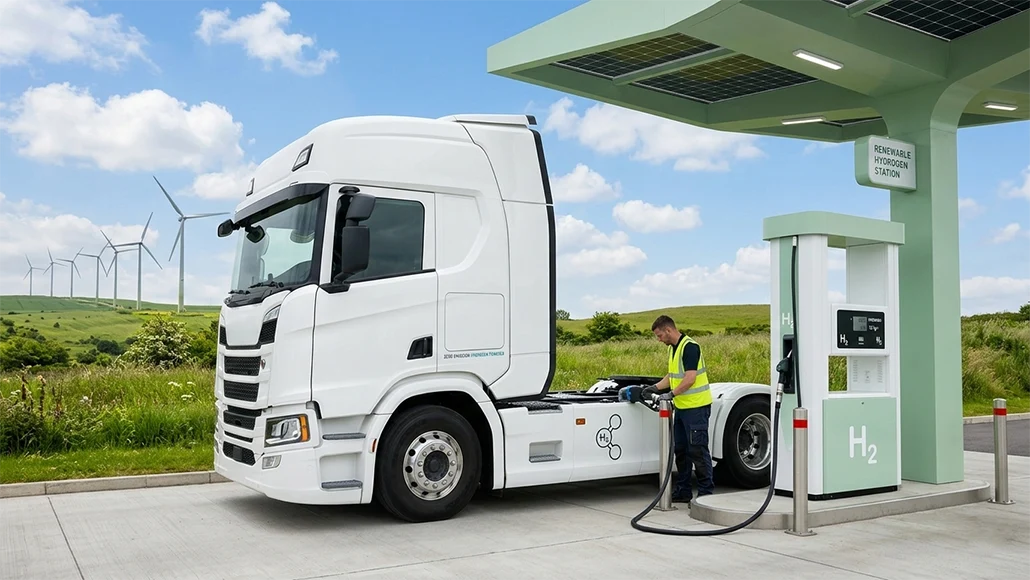
However, as the weight of the vehicle and the required range increase, the limitations of current battery technology become more apparent. The weight of the batteries needed for a 500-mile long-haul trip can significantly reduce the available payload, which is a critical factor for logistics operators. This is where hydrogen trucks enter the picture. Hydrogen offers a much higher energy density than current battery technology and can be refueled in a timeframe similar to diesel. This makes FCEVs a highly attractive option for heavy, long-distance transport where high utilization and payload capacity are paramount. The “hydrogen vs. electric” debate is slowly shifting toward a “hydrogen and electric” consensus, where each technology occupies the niche to which it is best suited.
The Hydrogen Supply Chain and “Green” Production
For hydrogen to be a true solution for fleet decarbonisation, it must be produced sustainably. Most of the hydrogen produced today is “grey” hydrogen, derived from natural gas through a process that releases significant amounts of CO2. The future of zero emission HGVs depends on “green” hydrogen, produced via electrolysis powered by renewable energy. This requires a massive scale-up of wind and solar capacity, as well as the development of a hydrogen distribution infrastructure that can reach the refueling stations. Some regions are exploring “blue” hydrogen, where the CO2 from natural gas production is captured and stored, as a transitional bridge while green hydrogen capacity is built out.
The logistics of moving hydrogen from the point of production to the truck’s tank is also a significant undertaking. Hydrogen can be transported as a compressed gas or a cryogenic liquid, each with its own energy and cost implications. For high-volume refueling stations, on-site electrolysis might be the most efficient solution, bypassing the need for transport entirely. This decentralized model of fuel production represents a radical departure from the centralized refinery-based model of the oil era, offering greater energy security but requiring a more complex and intelligent management of the energy grid.
Developing a Robust Fleet Decarbonisation Strategy
For a logistics company, creating a successful fleet decarbonisation strategy is a multi-year undertaking that involves much more than just purchasing new trucks. It requires a holistic assessment of the entire operation, from energy procurement and infrastructure to driver training and route planning. One of the first steps in this journey is a thorough analysis of current route profiles to determine which vehicles are best suited for early replacement. Often, the transition begins with “back-to-base” operations where the vehicles return to a central depot every night, simplifying the charging or refueling requirement. These early deployments serve as a learning ground for the organization, allowing them to refine their processes before moving into more complex long-haul operations.
As the fleet expands, the complexity of energy management increases significantly. Companies must consider the source of their energy; for a vehicle to be truly zero-emission, the electricity or hydrogen it uses must be generated from renewable sources. This leads many firms to explore power purchase agreements (PPAs) with wind or solar farms, or even to install their own on-site renewable generation. By securing a clean energy supply, businesses can ensure that their move toward green logistics is both environmentally sound and economically stable. This vertical integration of the energy supply chain is becoming a key strategic advantage for large-scale logistics providers.
Life Cycle Assessment and Environmental Integrity
A truly comprehensive fleet decarbonisation strategy must look beyond tailpipe emissions and consider the entire life cycle of the vehicle. This includes the environmental impact of manufacturing the batteries and fuel cells, as well as the eventual disposal or recycling of these components. “Zero-emission” must not simply mean shifting the pollution from the city center to the mining region or the manufacturing plant. This is why many companies are now demanding more transparency from their suppliers and are actively participating in circular economy initiatives. The goal is a truly sustainable freight transport system where the materials used in the vehicles are recovered and reused at the end of their life.
Infrastructure remains the great enabler of this transition. For battery-electric trucks, this means the installation of high-power charging stations at strategic locations along major transport corridors. The upcoming “Megawatt Charging System” (MCS) is set to be a game-changer, allowing heavy trucks to add significant range in just 30 to 45 minutes. For hydrogen trucks, the challenge is even greater, as an entirely new distribution and refueling network must be built from the ground up. This involves the construction of hydrogen production facilities, storage tanks, and high-pressure refueling stations. Collaboration between the public and private sectors is essential to ensure that this infrastructure is deployed in a coordinated and timely manner.
The Role of Regulatory Frameworks and Incentives
Government policy is perhaps the most significant catalyst for the shift toward zero emission HGVs and fleet decarbonisation. Across Europe and North America, we are seeing the introduction of stricter CO2 emission standards for heavy vehicles, as well as bans on the sale of new internal combustion engine trucks in the coming decades. These regulations provide the certainty that manufacturers and operators need to make long-term investment decisions. Without a clear regulatory roadmap, the risk of investing in unproven technology would be too high for many businesses.
In addition to regulations, financial incentives are playing a crucial role. Grants for the purchase of alternative fuel trucks, tax exemptions for clean vehicles, and exemptions from urban congestion charges all help to improve the business case for electrification and hydrogen. Furthermore, the introduction of carbon pricing and environmental taxes on diesel will gradually tip the economic scales in favor of zero-emission alternatives. For forward-thinking companies, moving early is not just about being “green”; it is about staying ahead of the regulatory curve and avoiding the risks associated with stranded assets. The “first-mover advantage” in zero-emission logistics can lead to stronger relationships with high-value customers who have their own ambitious net-zero goals.
Overcoming the Challenges of Transition
The road to net zero transport is not without its obstacles. The upfront cost of zero-emission trucks remains significantly higher than diesel equivalents, although the gap is narrowing as production scales up. There are also concerns about the availability of critical minerals for battery production and the overall capacity of the electrical grid to handle the increased load. Furthermore, the secondary market for electric and hydrogen HGVs is still in its infancy, which creates uncertainty around resale values. These are significant hurdles that require a coordinated effort from manufacturers, energy providers, and governments to overcome.
Despite these challenges, the momentum is undeniable. Every major truck manufacturer now has a zero-emission product roadmap, and some of the world’s largest logistics providers have already committed to fully decarbonizing their fleets by 2040 or sooner. These pioneers are proving that while the transition is difficult, it is achievable with the right combination of technology, strategy, and political will. By sharing data, collaborating on infrastructure, and pushing for supportive policies, the industry is collectively moving toward a cleaner, more sustainable future for global freight. The era of the diesel HGV is coming to an end, and the era of silent, clean, and intelligent transport is beginning.
Key Takeaways
Technological Synergy for Diverse Needs
Decarbonizing heavy freight requires a dual-track approach using both battery-electric and hydrogen fuel cell technologies. While battery-electric vehicles are ideal for regional and urban distribution due to their high efficiency and lower maintenance, hydrogen trucks provide the necessary range and payload capacity for long-haul operations. This technological synergy ensures that all segments of the freight industry have a viable, data-backed path to net-zero emissions without compromising operational performance.
Infrastructure and Policy as Foundations
The successful adoption of zero-emission HGVs is dependent on the rapid rollout of high-capacity charging and hydrogen refueling networks. Robust government policy, including stricter emission standards and financial incentives, provides the necessary framework for businesses to invest in alternative fuel trucks. A successful fleet decarbonisation strategy must be holistic, covering everything from green energy procurement to life cycle assessment, to ensure true environmental and economic sustainability.
