





















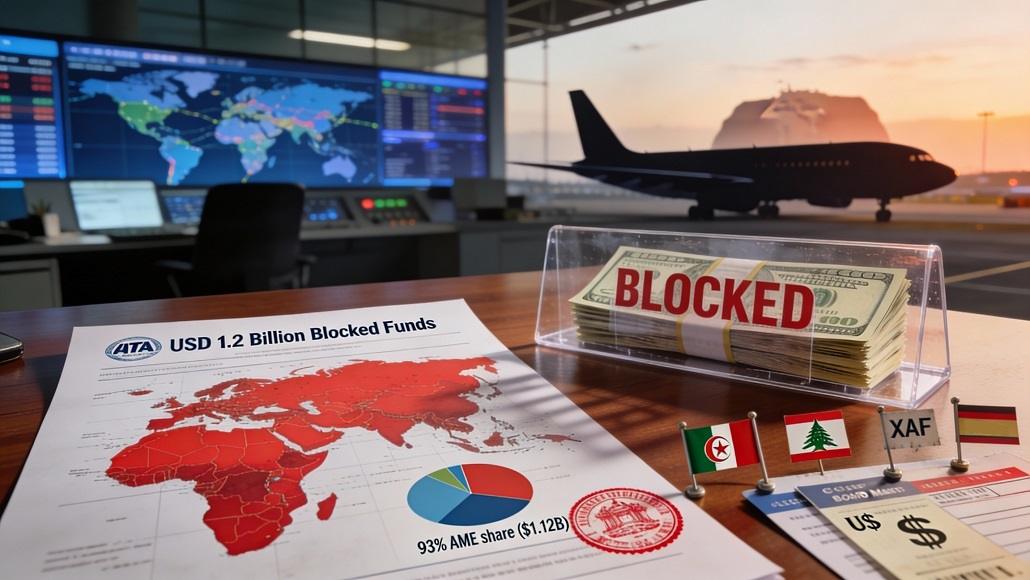
The International Air Transport Association – IATA has reported that $1.2 billion in airline funds blocked from repatriation by the governments as of the end of October 2025. A marginal enhancement of USD 100 million has been made ever since it was last reported in April 2025. Out of the total $1.2 billion in airline funds blocked that have been reported, 93% are trapped within the Africa and Middle East – AME region.
IATA, apparently, has called on governments to lift all the restrictions pertaining to currency repatriation and enable the airlines to access their revenues, particularly in US dollars, from their ticket sales, cargo sales, and any other activities, as guaranteed within the bilateral air service agreements along with treaty obligations. Restrictions go on to include the burdensome or inconsistent procedures in order to obtain repatriation approval, delays when it comes to obtaining approval, shortage or dearth of foreign exchange, or any other limitations that are imposed by the governments or central banks.
IATA’s Director General, Willie Walsh, opines that airlines do need dependable access to their revenues in U.S. dollars so as to keep operations running, pay their bills, and also maintain their all-important air connectivity. Governments have gone on to commit to unfettered repatriation of funds within bilateral agreements. Due to low margins and also major dollar-denominated costs, airlines go on to depend upon governments to fulfill that commitment. Besides, it is also in the interest of the governments to foster economic catalysts, which the airlines offer by connecting their economies across the world. That is why they urge the governments to help with the efficient repatriation of airline funds and also prioritize the same in foreign exchange allocations, even when the currency is in short supply.
Ten Nations are Accountable for 89% of Blocked Funds
Notably, there are ten countries throughout Africa, the Middle East, and South Asia that account for 89% of the overall blocked funds, which amount to USD 1.08 billion.
Country Highlights
Interestingly, for the first time, Algeria goes on to sit at the top of the list when it comes to countries with blocked funds. There are major increases that have been reported because of a new approval requirement made essential by the Ministry of Trade, hence adding to the already burdensome documentation needs. IATA goes on to urge the government of Algeria to eradicate the unnecessary processes as well as requirements for airlines.
Although the blocked funds in the XAF Zone have slightly dipped from USD 191 million since last reported in April 2025, the airlines continue to face the repatriation challenges in spite of the submission of the needed documentation. There is a call made to the BEAC in order to make the internal three-step validation process seamless and also enhance the processing times to continue clearing the backlog.
The AME region comprises 93% of the overall blocked funds throughout 26 countries, at USD 1.12 billion as of the end of October 2025.
As per Walsh, the political and economic instability are indeed major drivers of the currency restrictions throughout Africa as well as the Middle East, thereby resulting in large sums of blocked funds. They do recognize that allocation of foreign exchange is indeed a challenging policy decision; however, the long-term advantages for the economy as well as jobs outweigh the short-term financial gains.
Being crystal clear
In order to offer greater transparency on the issue of blocked funds, IATA has unveiled a web page in order to track the quarterly progress, offer background information, and also bring to the fore developments that have taken place.
