









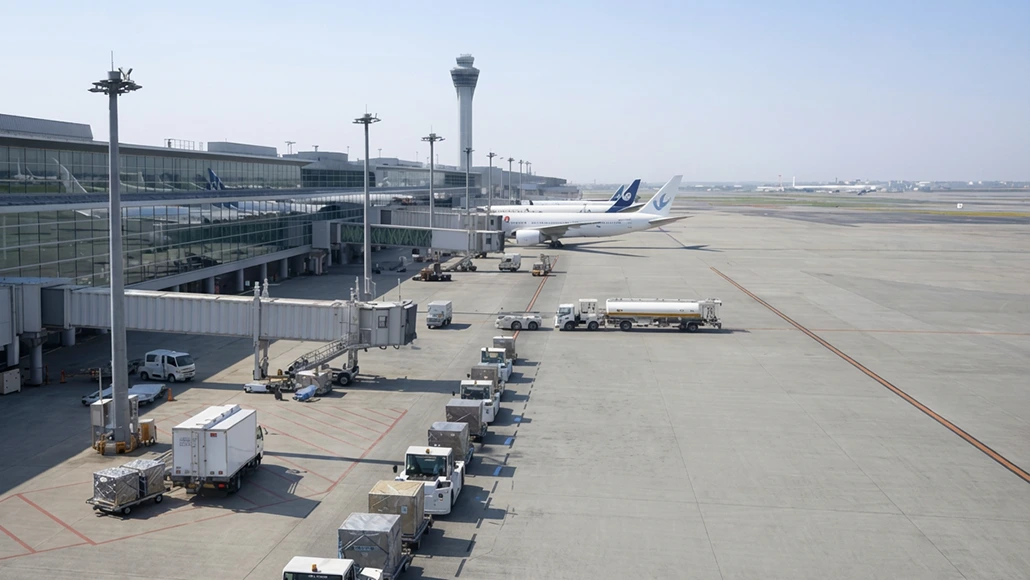
NEC Corporation has begun supplying vehicle management equipment to support autonomous driving operations in restricted areas of Tokyo International Airport, adding momentum to efforts to automate airport ground transport systems and strengthen the autonomous airport ground transport system used in daily operations. The deployment follows an order from the East Japan Civil Aviation Bureau under Japan’s Ministry of Land, Infrastructure, Transport, and Tourism and is intended to support the safe and efficient movement of autonomous vehicles at one of the world’s busiest airports.
The vehicle management equipment includes signal control systems that work in coordination with autonomous vehicles, along with camera systems installed to reduce blind spots in complex operating areas. The technology supports towing tractors equipped with Level 4 autonomous driving capability that are now operating within restricted zones at the airport. These autonomous towing tractors are operated by Japan’s two largest airlines, ALL NIPPON AIRWAYS CO., LTD. and Japan Airlines Co., Ltd., reflecting coordinated efforts among government authorities, airlines, and airport operators to modernize ground transport operations.
Rising air traffic volumes are putting more pressure on airports to lift productivity, deal with workforce constraints, and run operations more efficiently, especially in ground handling and vehicle movement. In response, the Ministry of Land, Infrastructure, Transport and Tourism, working with airlines and airport stakeholders, has been pushing the automation of towing tractors and buses used to move passengers and crew. Airport environments, however, are not the same as public roads and require autonomous driving systems that take into account aircraft movements, strict safety rules, and the different operating conditions found across runways, taxiways, and apron areas. Autonomous vehicles must also operate safely alongside human-driven vehicles, which means new communication methods are needed in place of traditional driver-to-driver coordination.
NEC’s vehicle management equipment supports autonomous driving by building on more than 50 years of experience in air traffic control and airport-related systems, and through collaboration with airlines and autonomous vehicle manufacturers. The system enables automatic signal control at intersections inside restricted airport zones, helping manage traffic where autonomous and human-operated vehicles operate side by side. Cameras installed in low-visibility areas also send video feeds to vehicle operators, allowing closer monitoring and supporting day-to-day safety management across ground operations within the autonomous airport ground transport system. As airports continue to pursue greater automation to improve efficiency and safety, NEC said it will continue applying digital technologies to support the development of next-generation mobility systems and more resilient transportation infrastructure.
